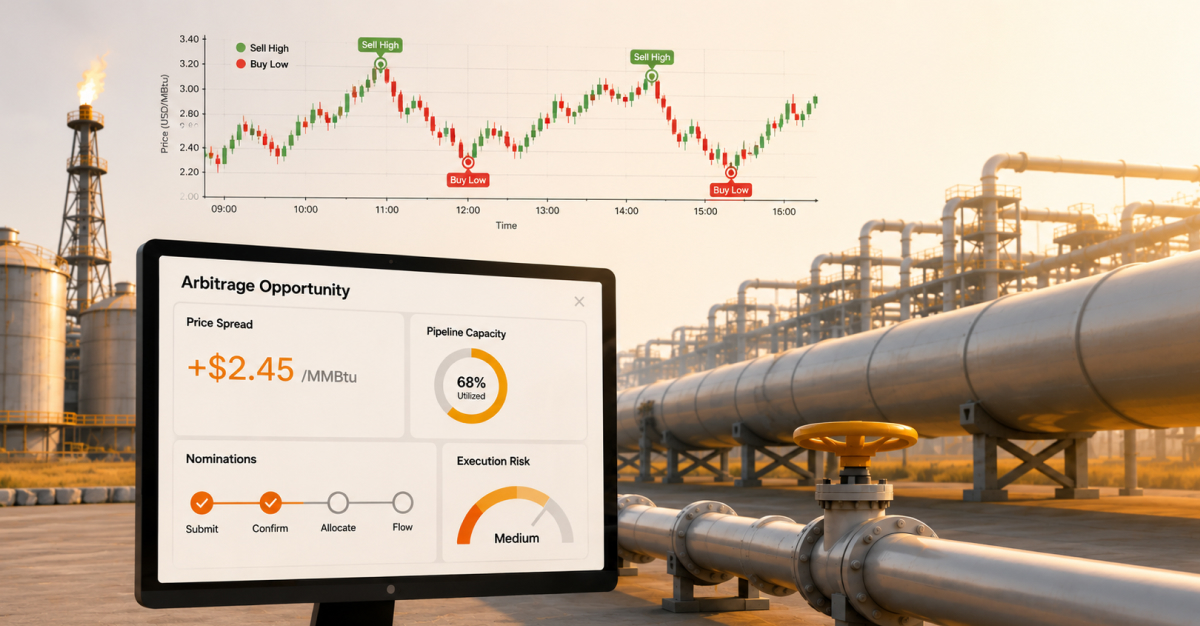
You can see a clean regional spread, calculate an attractive margin, and still end the day without an executable trade. The screen may be right. The opportunity may be real in theory. Yet a tariff condition, missing entitlement, constrained path, confirmation mismatch, or closing nomination window can stop the physical movement before value reaches the business.
That gap matters because physical energy arbitrage is not a pricing exercise alone. It is a constrained execution decision. Your economics must survive the network, the contracts, the operating day, and the controls that govern action.
We use energy arbitrage here in a specific sense: moving or timing physical natural gas across pipeline, storage, and market locations to capture a price difference. We are not describing exchange-traded or statistical arbitrage. In this operating context, our central argument is simple: a spread becomes valuable only after you know that you can execute it.
A correct price signal can still describe an impossible trade
Regional prices already reflect physical conditions. We can see that in the U.S. Energy Information Administration's analysis of major natural gas hubs, where pipeline interconnectivity, storage access, demand, infrastructure bottlenecks, and takeaway capacity help explain why prices separate across locations. EIA also lists pipeline availability and capacity as factors in natural gas price differences.
Those price differences can reveal opportunity, but they do not reserve transportation, establish contractual rights, or complete a nomination. Before your team can act, the apparent trade must pass at least five tests:
- Commercial entitlement: Do you hold the transportation, storage, receipt, and delivery rights required for the proposed path and volume?
- Tariff economics: Do rates, fuel, loss, imbalance, and other applicable charges leave enough margin after the full movement cost?
- Physical feasibility: Is capacity available at the relevant segments and points, and can current operating conditions support the movement?
- Timing and confirmation: Can upstream and downstream parties confirm the movement within the applicable nomination and scheduling cycle?
- Control readiness: Can you explain the recommendation, the governing rules, the excluded alternatives, and any exception that requires approval?
When any one test fails, the original spread can remain mathematically correct while the proposed trade becomes commercially or operationally unusable.
Where execution breaks down
1. Entitlements and tariffs define the decision space
Your route does not begin with every theoretically connected point. It begins with the rights you hold and the conditions attached to them. FERC explains that it regulates the rates, terms, and conditions of interstate pipeline transmission service, and its eTariff program requires natural gas pipeline tariffs and revisions to be filed electronically. That makes tariff logic part of the trade definition, not a compliance note added after optimization.
A system that finds the highest gross spread before it applies entitlements and tariff costs will produce avoidable false positives. It may also miss a workable alternative that uses a different receipt point, delivery point, storage action, volume, or time window.
2. Capacity and operating conditions can change the route
A path that worked yesterday may not remain available today. Planned maintenance, pressure conditions, storage availability, meter restrictions, critical notices, or competing firm demand can change what is feasible. We therefore need a current network view, not a static route catalog.
EIA's hub analysis shows the market effect clearly: limited capacity and infrastructure constraints can contribute to volatile premiums, discounts, and even negative prices at constrained locations. We treat those spreads as signals to investigate, not proof that a particular movement is available.
3. Nomination cycles turn time into a hard constraint
A current Department of Energy-hosted National Petroleum Council report describes nominations as shipper requests tied to a contract, receipt and delivery points, quantity, and gas day. It also explains that pipelines confirm and prioritize nominations using available capacity, contractual rights, tariff-defined scheduling priorities, and minimum timely, evening, and intraday cycles.
That sequence creates a practical deadline. If your team spends the available window reconciling spreadsheets, checking contracts, calling operators, and comparing route alternatives, the opportunity can decay before the decision becomes nominatable. Faster price analytics will not solve a late feasibility decision.
4. Fragmented rules force people to become the integration layer
You may have tariff terms in filed documents, entitlements in ETRM records, capacities in operational systems, nominations in scheduling platforms, and exceptions in email or expert memory. When those sources do not resolve into one decision context, your analysts and operators must translate between them under time pressure.
We do not view that manual work as evidence that your team resists automation. We view it as evidence that the rule and data model remains fragmented. People step in because they can recognize ambiguity, reconcile incomplete context, and decide when an exception needs escalation.
Why downstream validation creates false confidence
A common workflow detects a spread, ranks the economics, and then sends the preferred trade through feasibility and control checks. The sequence feels efficient because optimization starts with a smaller problem. Operationally, it pushes the hardest questions to the end.
We see three predictable consequences:
- False positives: You spend time validating trades that never had the rights, capacity, or timing required for execution.
- False negatives: You abandon an opportunity because the first route fails, even though another path, volume, or storage action could remain feasible.
- Trust erosion: Your team learns that every recommendation needs manual reconstruction, so the familiar route begins to feel safer than the optimized one.
The design problem is not that validation is too weak. It is that validation arrives too late. We need constraints to shape the search and optimization process from the beginning.
Our execution-first operating model
At RandomTrees, we frame executable arbitrage as one governed decision loop. We do not separate the price signal from the physical and commercial conditions that decide whether the signal can become action.
- Normalize rules without rewriting policy. We translate approved tariffs, contract terms, entitlements, timing rules, and operating constraints into a consistent structure while preserving source, owner, applicability, and effective date.
- Build the feasible route set first. We eliminate paths that violate known rights or operating limits before we compare net economics.
- Optimize inside the constraints. We evaluate route, volume, storage, timing, and cost together so a strong result is both economically attractive and operationally plausible.
- Carry the decision record with the recommendation. We retain the rules evaluated, binding constraints, excluded alternatives, cost inputs, data timestamps, and required confirmations.
- Escalate ambiguity instead of hiding it. We route stale rules, unresolved conflicts, unusual market conditions, and threshold breaches to an accountable human reviewer.
This operating model does not eliminate expertise. It moves expertise upstream into rule ownership, exception design, and approval thresholds, where judgment can improve many decisions instead of rescuing one trade at a time.
How we apply the model in our Arbitrage Detection Agent
We apply this model through our Arbitrage Detection Agent case study and our broader energy and commodity trading approach. Our design brings three coordinated capabilities into the same decision loop.
Route discovery
We map candidate pipeline and storage paths against operational, contractual, and capacity constraints. The objective is not to enumerate every connected route. It is to construct the set that remains relevant under the rights, data, and operating conditions available at decision time.
Deal optimization
We compare net economics across the feasible set, including route selection and volume allocation. By optimizing economics and feasibility together, we can surface an alternative when the highest-gross-spread path cannot be executed.
Nomination planning
We convert a validated opportunity into a proposed nomination plan aligned with scheduling cycles, required confirmations, volumes, and exception flags. Human approval remains available where your governance thresholds require it.
In our published case study, we report that one global energy company moved typical deal analysis from two to three hours to under 15 minutes, shortened decision-to-nomination cycles by about 60%, and recorded 3% to 7% higher arbitrage margin capture per deal. We present these as results from one described implementation, not as independent benchmarks or guaranteed outcomes for another environment.
What to measure in an executable-arbitrage pilot
A useful pilot should test whether your decision system improves execution quality, not whether a model can identify historical spreads. We recommend a bounded network, a representative set of market conditions, approved rules, and explicit acceptance thresholds.
Track at least six measures:
- Decision-to-nomination latency: Time from detected signal to an approved, schedulable plan.
- Executable recommendation rate: Share of recommended opportunities that pass confirmation and scheduling checks.
- Expected-to-realized margin variance: Difference between modeled economics and the margin realized after actual movement costs and outcomes.
- Manual exception rate: Share of decisions that require intervention, by cause and risk level.
- Rule and data traceability: Ability to reproduce the decision using the rule versions, source data, and timestamps available at the time.
- Downstream exception trend: Operational, settlement, or reconciliation issues associated with recommended movements.
Evaluate the measures by route type, contract class, market condition, and decision complexity. Averages can hide failure clusters that matter more than overall speed.
Where automation should stop
We do not treat an optimization result as permission to execute. Your operating model still needs human ownership of tariffs, contract interpretation, data quality, risk thresholds, and consequential exceptions.
We recommend mandatory review when a rule source is stale, two authoritative sources conflict, a proposed action exceeds a volume or value threshold, an operating notice invalidates the modeled network state, or the system cannot explain why an alternative was excluded. We also recommend conservative behavior when required confirmations or source data are missing.
Auditability supports that control. A decision record should let your trading, supply chain, operations, risk, and settlement teams see the same logic without reconstructing it from messages and spreadsheets. Explainability is therefore part of execution readiness, not an after-the-fact reporting feature.
The durable advantage is execution certainty
You do not create advantage by seeing a spread that everyone can see. You create advantage by determining, earlier and more consistently, which opportunity your organization can execute within its rights, infrastructure, timing, and control boundaries.
That shift changes the question from 'Is the price difference attractive?' to 'Which feasible plan can we approve and nominate now, and what evidence supports it?' Once you ask the second question, rules stop behaving like downstream vetoes and start shaping the decision itself.
We built our execution-first model to make that decision faster, more repeatable, and easier to defend without removing the judgment that physical energy operations still require.
Explore our energy and commodity trading capabilities and our Arbitrage Detection Agent case study, or talk with us about testing executable arbitrage against your network, contracts, nomination cycles, and control thresholds.