Energy Trading: Bringing execution discipline to energy arbitrage decisions across volatile trading networks

Turning price signals into executable decisions across complex energy networks

In energy and commodities markets, identifying a profitable spread is only the beginning. Real value depends on whether that opportunity can actually be executed under operational, contractual, and network constraints. This case study shows how the Arbitrage Detection Agent helped a global energy company reduce deal analysis time, improve route selection, accelerate nomination cycles, and turn arbitrage into a more scalable execution capability.

CLIENT SNAPSHOT
Our Valued Client at a Glance

Industry

Energy and Commodities

Key Stakeholder

Vice President Supply Chain

Primary Challenge

Turning theoretical arbitrage spreads into executable operational decisions

Operational Environment

Pipelines, storage facilities, and trading hubs across multiple markets

THE CHALLENGE
In volatile markets, opportunity disappears faster than manual analysis can keep up

Arbitrage opportunities exist constantly across locations, time windows, and contract structures in energy and commodities markets. But identifying a spread in theory is very different from executing it in practice.

A global energy company was operating a complex network of pipelines, storage facilities, and trading hubs across multiple markets. Price signals frequently indicated profitable opportunities between locations, but converting those signals into executable decisions required evaluating thousands of route possibilities while factoring in pipeline tariffs, contract entitlements, storage availability, and operational constraints.

The process remained heavily manual. Analysts had to assess routes one by one, validate feasibility across systems, and reconcile constraints before a decision could move forward.

2 to 3 hrs

Typical deal analysis time

Thousands

Potential route combinations

Multiple

Operational systems involved

Manual

Route feasibility validation

Slow

Decision to nomination cycles

Volatile

Market windows and price movements

WHY TRADITIONAL APPROACHES FELL SHORT
The issue was not seeing the opportunity. It was validating it fast enough to act.

Most trading environments already surface price spreads and potential arbitrage signals.

The real challenge begins after that.

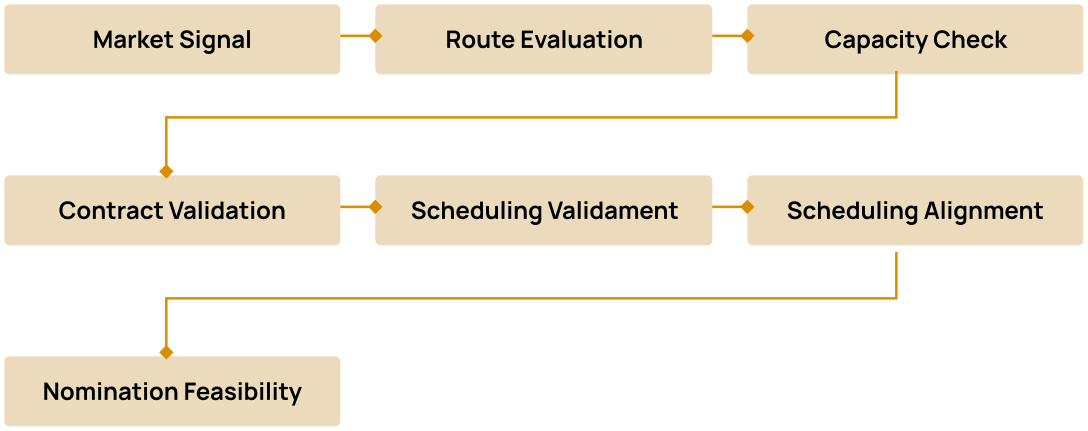
Teams still need to determine whether a route is operationally feasible, commercially valid, and executable within the relevant nomination window. That requires reconciling multiple variables across infrastructure, contracts, capacity, and scheduling systems.

Traditional analytics could highlight where a theoretical spread existed, but they could not reliably answer the more important question:

Can this deal actually be executed now?

THE SOLUTION
The Arbitrage Detection Agent introduced execution intelligence into the decision loop

Rather than adding another analytics layer, the organization implemented an Enterprise AI powered Arbitrage Detection Agent designed to evaluate arbitrage opportunities as executable operational decisions rather than theoretical price spreads.

Discovers feasible routes under operational constraints
Optimizes deal economics and route selection together
Converts validated opportunities into executable nomination plans
Creates traceable decisions with governance and audit visibility

HOW IT WORKED
How the Arbitrage Detection Agent worked in practice

To modernize accounts payable and reduce operational risk, the organization deployed Invoice 360, an intelligent invoice agent designed to bring interpretation, validation, matching, and execution into one governed workflow.

Route Discovery

Continuously maps feasible pipeline and storage routes while enforcing operational, contractual, and capacity constraints.

Deal Optimization

Evaluates economic opportunity and operational feasibility together, optimizing route selection and volume allocation.

Nomination Planning

Converts validated opportunities into executable nomination plans aligned with scheduling cycles.

Every recommendation is governed by a structured decision framework with traceable audit visibility.

RESULTS
From theoretical arbitrage to faster and more executable trading decisions

The implementation of the Arbitrage Detection Agent led to significant improvements across operational efficiency, margin capture, and governance, transforming the company's arbitrage execution capabilities.

Operational Efficiency

85%

Faster deal analysis

2 to 3 hrs <15 min

processing time

~60%

Shorter decision to nomination cycles

Automated

Route feasibility validation

Margin and ExecutionImprovement

3 to 7%

Higher arbitrage margin
capture per deal

Improved%

Route feasibility validation

Better

Route quality and allocation logic

Faster

Response to intraday market dislocations

Control and Governance

Traceable

Decision records

More consistent

Operational decisions

Improved

Compliance andreconciliation visibility

Auditable

Execution pathtransparency

WHAT CHANGED FOR FINANCE TEAMS
From analyst driven route evaluation to system supported execution planning

The biggest shift was not just in processing speed. It was in how finance teams operated.

Before deployment, teams were spending time on repetitive handling, reconciliation, and exception chasing. After deployment, that work moved into a more governed workflow where invoice decisions were visible, traceable, and easier to control.

Finance teams were no longer buried inside the mechanics of invoice movement. They were positioned closer to where real value lives:

  • Reviewing meaningful exceptions
  • Maintaining financial control
  • Improving execution confidence
  • Reducing downstream disruption

The most important shift was not just faster analysis. It was a change in how arbitrage decisions were made.

Previously, opportunities were evaluated sequentially by analysts who had to balance price signals with infrastructure realities, contractual limits, and operational timing. That process depended heavily on manual expertise and often struggled to keep pace with market volatility.

After deployment, the organization moved to a more integrated decision loop where:

  • economic opportunity
  • route feasibility
  • operational constraints
  • nomination planning

were evaluated together rather than in disconnected steps.

WHY THIS MATTERS
In energy markets, the ability to validate execution can matter as much as the opportunity itself

In volatile energy and commodities environments, profitable opportunities emerge and disappear quickly.

The organizations that win are not just the ones that detect price dislocations. They are the ones that can determine, with confidence and speed, which opportunities are actually executable across the real network.

The Arbitrage Detection Agent embeds execution intelligence directly into arbitrage decision-making, allowing organizations to move from opportunistic analysis to a more scalable operational capability.

The future of arbitrage performance will not be defined only by who sees the spread first. It will be defined by who can act on it with the least friction.

Bring intelligence into every financial workflow
See how RandomTrees helps energy and commodities organizations move from theoretical opportunity to executable decision intelligence.