By clicking “Accept All Cookies”, you agree to the storing of cookies on your device to enhance site navigation, analyze site usage and assist in our marketing efforts.
By clicking “Accept All Cookies”, you agree to the storing of cookies on your device to enhance site navigation, analyze site usage and assist in our marketing efforts.
From Alerts to Action: An Agentic Operating Model for Utilities
Utility Operations AI Agent: From Fragmented Signals to Coordinated Action
At 7:08 a.m., a utility operator sees five versions of the same emerging problem.
A group of meters has stopped reporting. A transformer temperature trend has moved outside its normal range. Two related work orders are incomplete. A weather alert shortens the available field window. The crew schedule lives elsewhere, and the asset’s last inspection note is buried in another system.
No individual signal is the operating picture. The decision appears only when those signals are assembled: What needs attention first, why, and what can the team safely do next?
That is the job of a utility operations AI agent. It is not a new control system and it should not become an ungoverned path into physical operations. It is a decision layer that connects approved context, routes work to specialized agents, and gives operators a prioritized recommendation with the evidence needed to accept, change, or reject it.
The distinction matters. Utilities already run sophisticated platforms for metering, asset records, outage management, grid control, workforce scheduling, and market operations. The coordination gap sits between them.
Why utility operations have reached a coordination gap
Operational data volume is no longer the limiting factor. The U.S. Energy Information Administration counted approximately 140.5 million advanced metering infrastructure meters in 2024, up from 64.7 million in 2015. That number says nothing about exception rates or real-time availability, but it illustrates the scale of one operational data source alone (EIA).
The grid itself is becoming more dynamic. Distributed energy resources, storage, electric vehicles, flexible loads, extreme weather, and new large customers add more actors and constraints to decisions that once followed a more predictable pattern. The U.S. Department of Energy identifies near-term AI opportunities across grid operations and reliability, predictive maintenance, anomaly detection, resilience, forecasting, and operator decision support. DOE also warns that grid AI must be rigorously validated, interpretable, secure, and deployed with humans in the loop (DOE).
The result is a familiar operational paradox: more visibility can produce more work. A meter exception needs customer, device, and network context. An asset alarm needs condition history, criticality, failure consequences, and a maintenance window. A dispatch decision needs crew skills, location, access, parts, safety requirements, and current priorities. A storm plan needs observed conditions, forecasts, grid topology, work backlog, and mutual-aid assumptions.
Traditional dashboards help teams see. A utility operations AI agent should help them decide—within explicit boundaries.
What a utility operations AI agent actually does
A utility operations AI agent serves as a centralized operational cockpit for questions and events that cross system boundaries. It can:
retrieve current context from approved operational and enterprise sources;
determine which specialized agent or sequence of agents should handle the request;
apply business rules, constraints, and risk thresholds;
compare related signals and identify missing information;
prepare a recommendation, priority, owner, and next action;
show the evidence, freshness, confidence, and assumptions behind that recommendation; and
route uncertain or high-impact cases to the right person.
RandomTrees describes its broader agent architecture as a layered platform combining a workflow-specific interface, orchestration, specialized agents, enterprise-system integration, and governance and observability. Its utility practice similarly emphasizes coordinated workflows across grid, distribution, customer, asset, and infrastructure operations (RandomTrees Agent Marketplace, RandomTrees Utilities).
The operating principle is simple: coordinate decisions across existing systems; do not erase the systems’ ownership of records, controls, or accountability.
Available agents
The proposed Utility Operations AI Agent brings four focused agents into one workflow.
Exception Triage Agent
The Exception Triage Agent monitors meter exceptions, missing work orders, aged backlog, and operational anomalies. Its value comes from grouping and prioritizing, not merely detecting.
For each exception, a useful output should answer:
• What happened, and when?
• Which asset, customer, location, or work order is affected?
• Is the signal isolated or part of a cluster?
• What severity and business-impact rules were applied?
• Which required fields or data sources are missing?
• Who owns the next step, and by when?
This agent can reduce the time operators spend moving between queues, but it should expose its prioritization logic. A severity label without evidence is another alert.
Predictive Reliability Agent
The Predictive Reliability Agent analyzes infrastructure performance, forecasts potential failures, identifies contributing risk factors, and supports proactive maintenance planning.
The word predictive needs discipline. A failure-risk score is probabilistic, asset-specific, and sensitive to data quality and operating regime. The agent should therefore present a forecast horizon, confidence or calibration information, the strongest contributing factors, comparable history, and the cost of a false negative—not only a red, amber, or green indicator.
For electric infrastructure, that may mean combining sensor trends, loading, weather exposure, asset age, inspection results, and maintenance history. For water assets, it may include condition, criticality, service consequences, and life-cycle cost—the same factors emphasized in the EPA’s Effective Utility Management framework (EPA). For pipelines, PHMSA’s integrity-management approach similarly centers on integrated data, threat identification, risk assessment, continual evaluation, and prioritization of higher-risk segments (PHMSA).
The agent’s job is to improve the maintenance decision, not to make uncertainty disappear.
Dispatch Optimization Agent
The Dispatch Optimization Agent prepares field-work schedules, priorities, routes, and resource allocations.
Route length is only one variable. A defensible dispatch plan considers:
• task priority and service commitments;
• crew skills, qualifications, shift limits, and safety requirements;
• asset access, site hazards, and stop-work conditions;
• parts, equipment, permits, and prerequisite work;
• geography, traffic, weather, and work windows;
• critical customers and restoration dependencies; and
• the operational cost of reassignment or interruption.
Research on technician routing in electricity distribution treats dispatch as a constrained team-formation and sequencing problem, which is closer to the real utility decision than a shortest-path exercise (Computers & Operations Research).
The safest starting pattern is recommendation. The agent proposes a schedule and explains the tradeoffs; a dispatcher approves or adjusts it. Automated updates can follow only where permissions, reversibility, and operating policy support them.
Market Intelligence Agent
The Market Intelligence Agent monitors network chokepoints, calendar-driven events, external signals, and competitive or market factors that may affect operations.
“Market intelligence” should be interpreted broadly enough to support the operational decision, but narrowly enough to remain evidence-based. Relevant context may include:
severe-weather alerts and forecast changes;
planned events, construction windows, and local access restrictions;
transmission, pipeline, storage, terminal, or transportation constraints;
fuel, power, or commodity signals that alter operational priorities; and
external developments that create a foreseeable load, supply, staffing, or logistics risk.
For natural gas, EIA identifies weather, storage, infrastructure constraints, supply and demand, and competing fuels as interacting price and availability drivers. These inputs do not produce a deterministic forecast; they give operators context for scenario planning (EIA).
External feeds also need operating controls. The National Weather Service exposes machine-readable forecasts, observations, and geographically filtered alerts, but its documentation notes rate limits, possible delays, and service changes. The agent should retain source timestamps, distinguish observations from forecasts, monitor feed health, and support fallback paths (NWS).
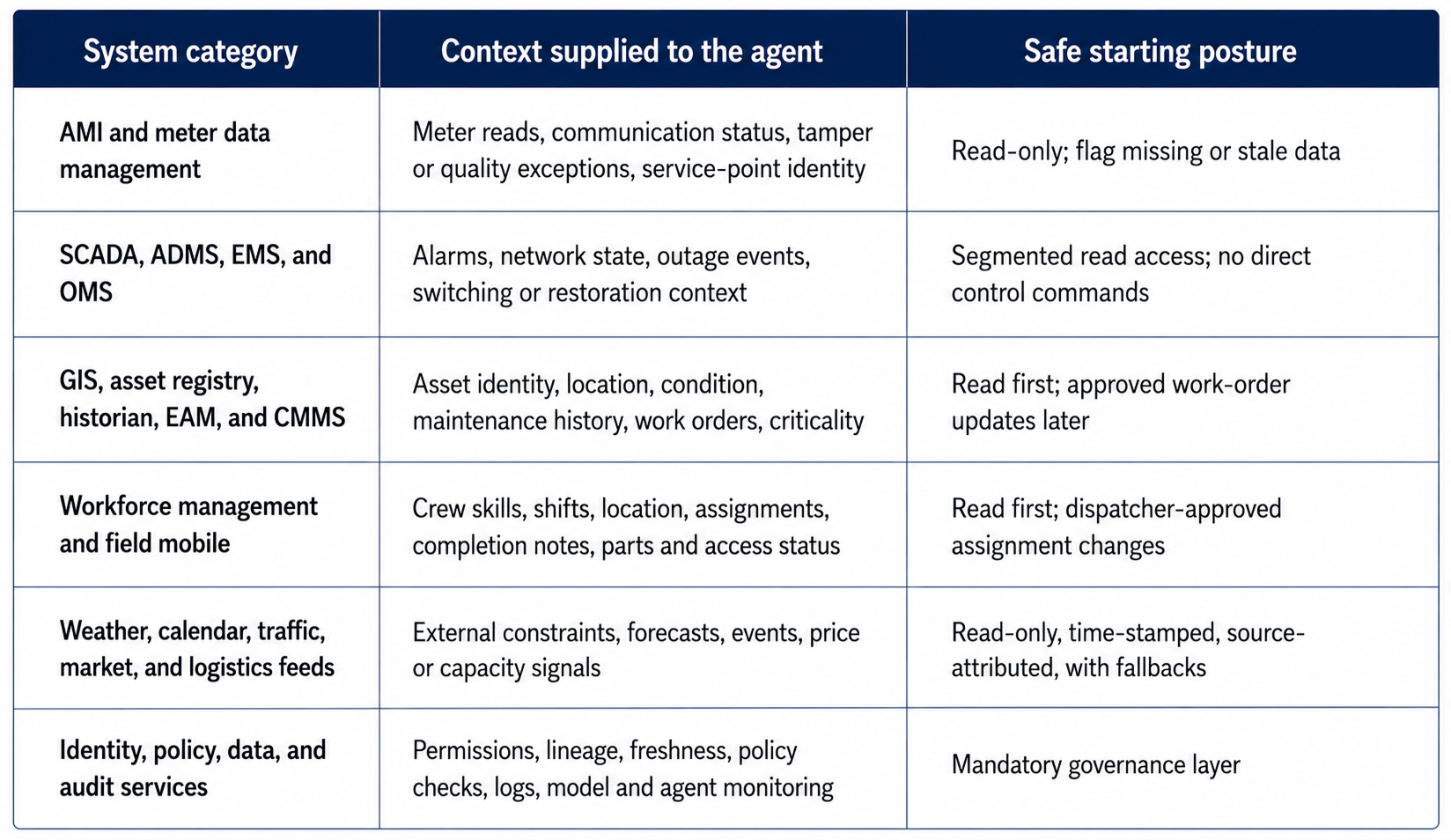
Integrated tools: what the cockpit should connect
The specific connectors for any deployment must be confirmed during discovery. The architectural pattern, however, is consistent: read context from governed systems, preserve system-of-record ownership, and allow write actions only where the role and risk justify them.
This is why a credible utility agent is more than a language model placed over a data lake. The agent needs stable asset and service-point identities, common terminology, current timestamps, scoped permissions, validated tool inputs and outputs, and a place to record what happened.
Agent architecture: how orchestration turns a question into evidence
The architecture can be expressed as a controlled decision loop:
Operator question or operational event ↓ Workflow interface + orchestration layer ├─ selects specialized agent(s) ├─ applies policy and access rules └─ manages sequence, retries, and handoffs ↓ Exception Triage | Predictive Reliability Dispatch Optimization | Market Intelligence ↓ Governed retrieval from operational and enterprise systems ↓ Recommendation card Evidence | freshness | confidence | constraints | owner | next action ↓ Human approval, adjustment, escalation, or rejection ↓ Approved system update + end-to-end audit trail
Multi-agent design is useful when responsibilities remain bounded. NREL has explored multi-agent orchestration for grid problems such as demand response, where utility, market, consumer, and evaluation agents contribute different objectives to a shared plan (NREL). In operations, the same principle can separate exception severity, asset risk, workforce feasibility, and external context so that no single agent silently optimizes the wrong objective.
The orchestration layer should also know when to stop. Missing identifiers, stale sensor data, conflicting work status, low model confidence, policy violations, or unavailable tools are reasons to abstain or escalate—not invitations to improvise.
Agent in action: a transformer risk becomes a field decision
Consider a distribution utility preparing for afternoon storms.
An event enters the cockpit. A cluster of meter communication exceptions appears downstream of a transformer. The transformer’s recent temperature trend is elevated, and an open inspection order lacks an access note.
Exception triage assembles the case. The agent correlates the meter cluster, work-order gap, asset identity, and affected service points. It ranks the case above isolated meter exceptions because multiple signals point to the same location.
Predictive reliability evaluates risk. The agent compares loading, temperature history, prior inspections, asset age, and weather exposure. It reports elevated short-horizon risk, lists the strongest factors, and shows which data are missing.
Dispatch optimization tests feasibility. The agent identifies a qualified crew, required equipment, travel time, access dependency, and the latest safe work window. It explains which lower-priority job would move if the inspection is accepted.
Market intelligence adds external context. A newer weather alert moves the storm window forward, while a local event and road restriction narrow one route. The agent timestamps each external signal.
The operator receives one recommendation. The cockpit proposes an inspection priority, owner, crew, route, and deadline. It includes evidence links, confidence, constraints, and an explicit note that no switching action has been taken.
A person remains accountable. The dispatcher confirms the plan, corrects the access note, and approves the work-order update. The final decision and the agent’s contribution are logged.
The win is not autonomous control. It is less time spent reconstructing the same situation in five systems, with a clearer basis for the accountable decision.
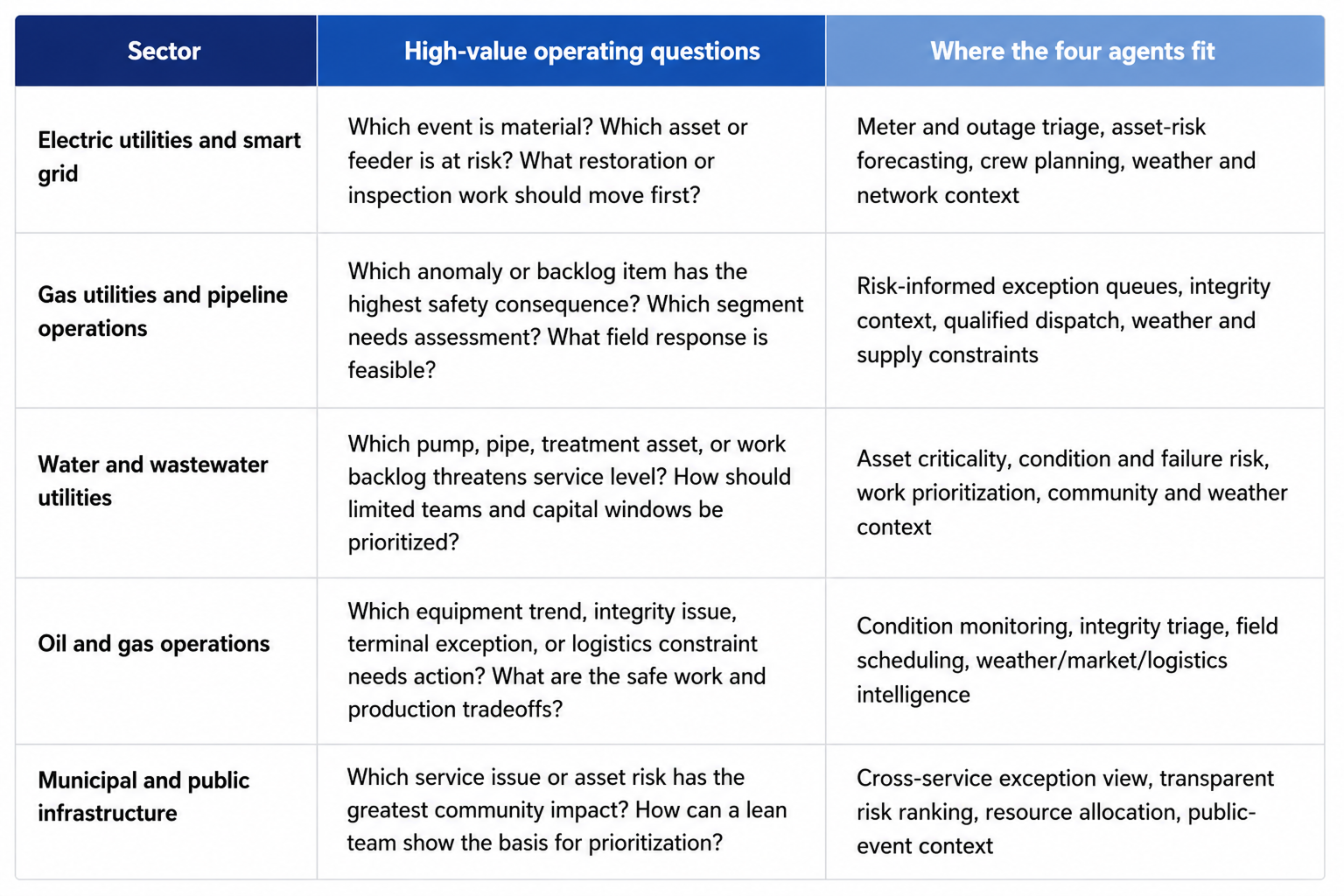
How the pattern adapts across utilities and infrastructure
The four-agent model is portable because the operating questions repeat even when assets and regulations change.
The public-sector case deserves special attention. APPA’s 2026 statistical report lists 1,998 public-power providers serving about 25.5 million customer accounts in 2024. Many municipal entities also operate water, wastewater, gas, broadband, or other infrastructure. A shared cockpit can help a lean organization coordinate scarce expertise, but it must also support public accountability: local policy, records retention, procurement rules, accessibility, privacy, cybersecurity, and explanations that withstand oversight (APPA).
Business wins: measure the decision, not the demo
The right value measures begin with the workflow the agent is supposed to change.
Reliability metrics need context. EIA defines SAIDI as the annual non-momentary interruption duration experienced by the average customer, SAIFI as interruption frequency, and CAIDI as average restoration duration. Major-event conditions can dominate annual results, so measures should be segmented with and without major events where applicable (EIA).
Avoid a single “hours saved” estimate detached from quality. Faster triage is not a win if it creates more false escalations. A shorter route is not a win if the crew lacks the right qualification or part. A predictive alert is not a win if operators cannot see why it appeared.
Controls for safety-critical and public-service environments
Utilities should treat agent autonomy as a permission design problem, not a marketing label.
Separate advice from execution. Read access does not imply write access. Work-order creation is different from assignment; assignment is different from a control-system command.
Keep physical control paths bounded. NIST’s OT guidance emphasizes that operational technology has distinctive safety, reliability, and performance requirements. Agent integration should respect segmentation, least privilege, allowlisted tools, and fail-safe operating procedures (NIST SP 800-82 Rev. 3).
Expose provenance and freshness. Every recommendation should identify the records, forecasts, rules, and model outputs it used, along with timestamps and missing inputs.
Quantify uncertainty and permit abstention. The system should route low-confidence, out-of-distribution, conflicting, or high-consequence cases to qualified people.
Make human oversight meaningful. The reviewer needs enough evidence, time, and authority to intervene. In pipeline environments, PHMSA’s control-room framework explicitly centers controller performance and abnormal and emergency response (PHMSA).
Evaluate the full workflow. Test retrieval, identity matching, business rules, optimization constraints, permissions, latency, failure modes, audit traces, and user decisions—not only model accuracy.
Monitor after launch. Track drift, stale sources, tool failures, repeated overrides, policy violations, unusual resource use, and downstream incidents.
The NIST AI Risk Management Framework offers a useful lifecycle vocabulary: govern, map, measure, and manage. For a utility operations agent, those practices must extend beyond the model into data, identity, tools, orchestration, user interface, approvals, and production evidence (NIST AI RMF).
A practical path from one decision to an operating capability
Start with a bounded decision, not an enterprise-wide promise.
Choose one recurring decision. Good candidates have visible delay or risk, an accountable owner, enough historical cases, and a measurable baseline. Meter-exception prioritization, backlog cleanup, inspection planning, or dispatcher decision support are stronger starting points than autonomous control.
Map the evidence and identifiers. Confirm how an asset, service point, location, customer, crew, and work order are represented across systems. Define freshness, ownership, lineage, and error handling.
Run in shadow mode. Let the agent assemble evidence and prepare recommendations without changing operational records. Compare its priorities with expert decisions across normal, storm, sparse-data, and unusual cases.
Evaluate business-task performance. Measure task correctness, missed high-risk cases, false escalations, decision time, user acceptance, data gaps, audit completeness, and failure containment.
Introduce controlled actions. Add reversible, low-impact writes first, such as preparing a draft work-order update. Require approval for assignments and high-consequence actions.
Expand only after the workflow is stable. Add agents, data sources, sites, or permissions when the existing operating envelope remains measurable and governable.
This approach creates reusable capability. Once identity, provenance, permissions, evaluation, and intervention work for one decision, the utility has a stronger foundation for the next.
From operational visibility to coordinated action
Utility operations do not need another surface that shows every alert equally. They need a controlled way to decide which signal matters, which evidence supports it, which field action is feasible, and where a person must intervene.
A Utility Operations AI Agent can provide that operating layer. Exception Triage organizes the queue. Predictive Reliability makes risk factors visible. Dispatch Optimization turns priority into a feasible field plan. Market Intelligence adds the external conditions that change the decision. Agentic orchestration brings those perspectives into one recommendation and one audit trail.
RandomTrees positions its utility and agent platforms around this move from fragmented monitoring to coordinated execution. The right evaluation is concrete: select one workflow, connect governed data, preserve human control, measure the decision end to end, and prove that the agent improves operational judgment before expanding its reach.
Evaluate a Utility Operations AI Agent against your assets, work queues, dispatch constraints, and governance requirements.
FAQ
What is a utility operations AI agent?
A utility operations AI agent is a governed decision layer that coordinates specialized AI capabilities across utility data and workflows. It can prioritize exceptions, assess asset risk, prepare field-service plans, add weather or market context, and present a traceable recommendation for human review.
How is a utility operations AI agent different from a dashboard?
A dashboard visualizes status and metrics. An operations agent can assemble context around a specific question, route work to specialized agents, apply rules and constraints, identify missing evidence, and prepare a next action. The dashboard shows; the agent supports a decision.
Can an AI agent connect to SCADA, ADMS, OMS, AMI, GIS, and work-management systems?
The architecture can connect to approved operational and enterprise systems through governed APIs, connectors, or data services. The exact integrations, data latency, and permissions must be validated for each deployment. A safe starting point is segmented, read-only access rather than direct control commands.
Can the agent automatically dispatch crews or control grid equipment?
Those are separate permissions with different risks. A utility can begin with dispatch recommendations and dispatcher approval, then consider narrowly scoped, reversible updates after evaluation. Physical switching or control-system actions require much stronger engineering, regulatory, cybersecurity, safety, and human-control safeguards and may remain outside the agent’s scope.
Does this operating model apply to municipal utilities, water, and oil and gas?
Yes. The assets and rules differ, but the core decisions repeat: prioritize exceptions, understand failure risk, allocate qualified field resources, and account for external constraints. Each sector still needs domain-specific data, risk models, permissions, safety controls, and evaluation.
Where should a utility start?
Choose one recurring, measurable decision with an accountable owner and usable data. Run the agent in read-only or shadow mode, compare its recommendations with expert decisions, measure missed risks and false escalations, and add controlled actions only after the workflow proves reliable.