By clicking “Accept All Cookies”, you agree to the storing of cookies on your device to enhance site navigation, analyze site usage and assist in our marketing efforts.
By clicking “Accept All Cookies”, you agree to the storing of cookies on your device to enhance site navigation, analyze site usage and assist in our marketing efforts.
RAG vs. Hybrid RAG for Enterprise AI Search
Compare vector-only and hybrid retrieval, understand when hybrid RAG is justified, and identify practical implementation and evaluation requirements
An employee asks an AI assistant, “What is the cancellation policy for contract CTR-2026-184?”
The assistant returns a clear answer and cites a genuine cancellation clause. There is only one problem: the clause belongs to a different contract.
This is a retrieval failure disguised as a successful answer. The language model did what it was asked to do with the context it received. The system failed earlier, when it found content that was similar to the question but missed the exact evidence the user needed.
That gap often appears when retrieval-augmented generation (RAG) moves from a controlled pilot into enterprise workflows. Semantic similarity is powerful, but enterprise questions also depend on identifiers, dates, document versions, access rules, and specialized terminology. Hybrid RAG addresses that reality by combining retrieval signals instead of asking one method to solve every search problem.
First, a terminology distinction
RAG describes a pattern: retrieve external evidence, provide it to a generative model, and use that evidence to support an answer. It does not require a single type of search. The original RAG research used a dense vector index, but production RAG systems may retrieve through full-text search, vector search, filters, databases, APIs, or a combination of these.
For clarity, this article uses vector-only RAG for a pipeline whose primary retrieval signal is embedding similarity, and hybrid RAG for a pipeline that combines semantic retrieval with lexical search and, where needed, metadata or structured retrieval.
That distinction matters. The real decision is not “RAG or no RAG.” It is which retrieval design gives the model the right evidence.
What vector-only RAG does well
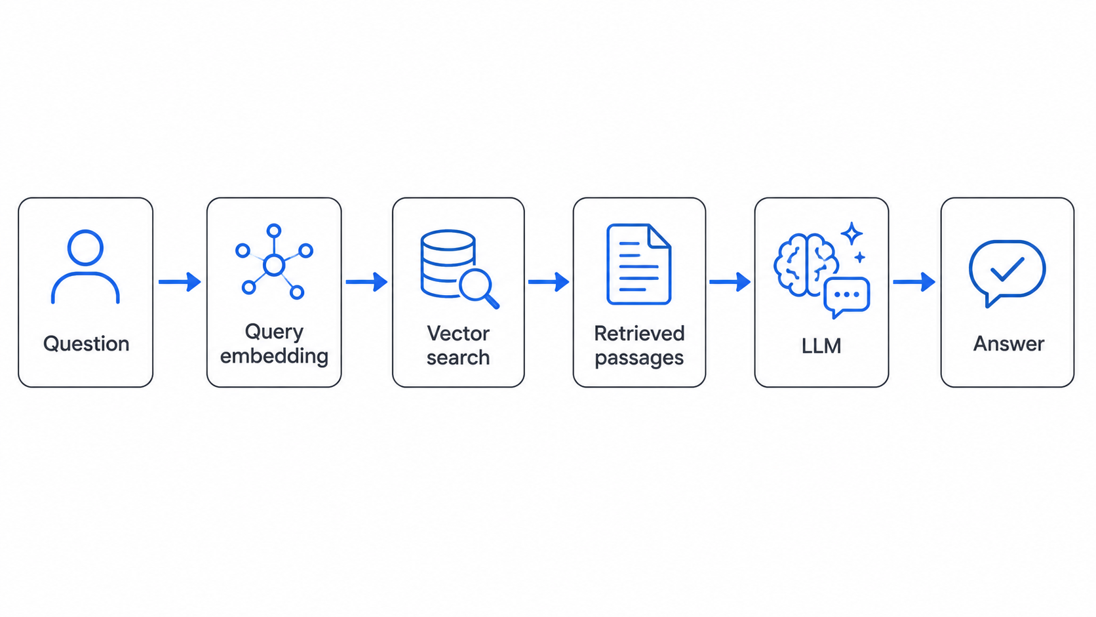
A vector-only pipeline typically follows this path:
Documents are divided into passages, or chunks, and converted into embeddings. The user’s question is embedded using the same model. The search system then retrieves chunks that are close to the query in vector space.
This works well when meaning matters more than exact wording. A question such as “Can I work from home?” can retrieve a policy that says “Employees may work remotely up to two days per week,” even though the wording is different.
That ability to bridge paraphrases, synonyms, and natural-language variation makes dense retrieval valuable for policy discovery, knowledge-base questions, research assistance, and other exploratory tasks. It also explains why many RAG prototypes begin with a vector database.
The limitation is equally important: similarity is not identity.
Where semantic search alone breaks down
Enterprise knowledge contains strings and boundaries that embeddings may not represent reliably. Consider these examples:
• Contract: CTR-2026-184
• Claim: CLM-784521
• Product: SKU-84721
• Database error: ORA-01555
• Policy version: POL-US-4.2
These values carry operational significance, but little standalone semantic meaning. A user entering one of them is usually asking for that exact record, not a conceptually similar one. Microsoft’s hybrid search guidance for Azure DocumentDB uses the same distinction: vectors handle paraphrases well, while lexical retrieval is better suited to rare terms and identifiers such as SKUs.
Vector-only retrieval can also struggle when:
several documents discuss the same topic but apply to different regions, business units, or effective dates;
an acronym or internal term is rare, overloaded, or absent from the embedding model’s training context;
the correct answer requires both an unstructured document and a structured record;
small textual differences, such as “included” versus “excluded,” change the decision;
many near-duplicate policies or product manuals compete for the top retrieval positions.
A better embedding model may improve semantic retrieval, but it does not remove the distinction between conceptual similarity and exact matching. The solution is often to give the retrieval layer more than one signal.
How hybrid RAG works
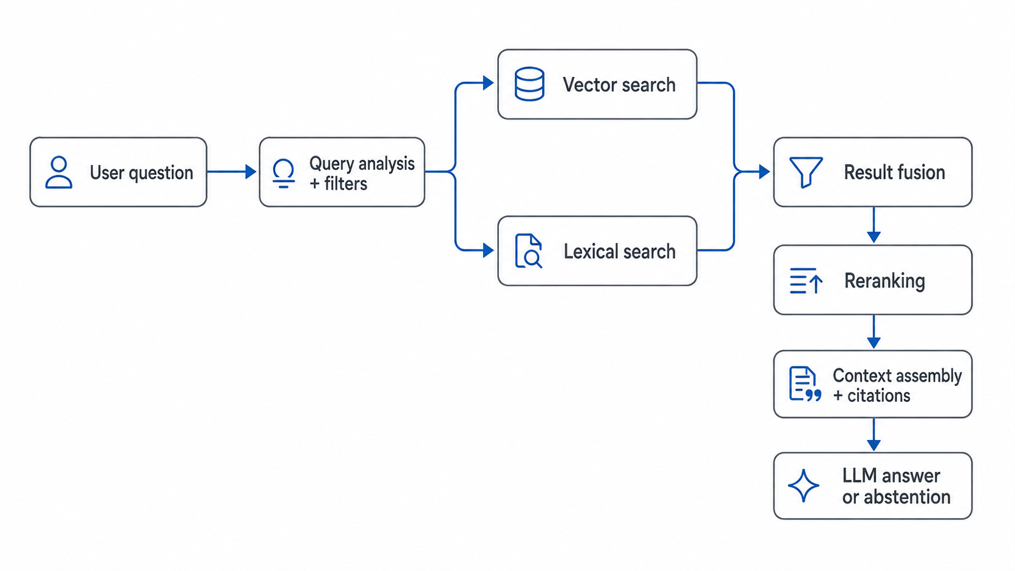
The most common hybrid approach runs dense vector search and lexical full-text search in parallel. It then combines the ranked results, optionally reranks the strongest candidates, and sends limited evidence set to the language model.
Each stage has a different job.
1. Query analysis identifies what must remain exact
Before retrieval, the system can identify contract numbers, product codes, dates, regions, document types, or other entities. It may preserve those values for exact lookup while sending the full natural-language question to semantic search.
This stage can also resolve common aliases, normalize formatting, or split a compound question into smaller retrieval tasks. Query transformation should preserve the original user question so that optimization does not silently change intent.
2. Lexical and vector search retrieve different kinds of relevance
Vector search looks for passages with similar meaning. Lexical search looks for matching terms and usually ranks them using an algorithm such as BM25. The two result sets may overlap, but each can recover evidence the other misses.
One technical detail is easy to overlook: full-text search is not automatically an exact-ID lookup. A text analyzer may split CTR-2026-184 at punctuation or normalize it in an unexpected way. Important identifiers should be preserved in dedicated, non-analyzed fields or queried through exact filters. Elastic’s full-text and filter documentation illustrates this distinction between analyzed text and keyword fields used for exact matching. Index design still matters.
3. Metadata narrows the valid evidence set
Search relevance cannot decide whether a user is authorized to see a document or whether an outdated policy is applicable. Metadata such as region, effective date, business unit, document type, status, and access group can constrain retrieval to the valid scope.
Microsoft’s RAG architecture guidance notes that enriched chunk metadata can support searches beyond semantic similarity, while its secure multitenant RAG guidance treats authorization-driven filtering as a core design requirement. Hybrid search improves relevance; it is not a security boundary. Permission enforcement must occur before restricted content reaches the model.
4. Result fusion combines unlike rankings
Lexical and vector scores are produced on different scales, so adding their raw scores is usually not meaningful. Reciprocal Rank Fusion (RRF) avoids that problem by using each document’s position in the ranked lists rather than comparing raw scores.
Microsoft’s retrieval guidance describes RRF as a score-free way to merge results from methods such as BM25 and cosine-similarity search. The original RRF research established it as a simple, effective method for combining rankings from multiple information-retrieval systems.
RRF is a useful starting point, not a universal default. Some applications need weighted fusion, field boosting, rule-based promotion of exact identifiers, or a learned ranking model. The right balance should come from representative queries, not intuition alone.
5. Reranking selects the strongest evidence
Fusion creates a combined candidate list. A reranker then evaluates the query and each candidate more closely, often with a model that considers both together. Its purpose is to move the best evidence toward the top before context is assembled.
Fusion and reranking are related but different:
• Fusion combines ranked lists from multiple retrieval methods.
• Reranking reassesses the combined candidates against the question.
Retrieving broadly can improve recall, but sending every candidate to the language model increases cost and can dilute the evidence. Reranking helps reduce that candidate set. It still cannot recover a document that neither first-stage retriever found.
An illustrative enterprise use case: insurance claims
Imagine an insurer building an assistant for claims specialists. The system can access policy documents, claim records, customer submissions, adjuster notes, and approved guidance.
A specialist asks:
Why was claim CLM-784521 partially rejected, and which policy clause supported the decision?
This question contains at least two retrieval needs. The system must locate the exact claim and identify the policy language that applied on the relevant date.
A practical hybrid workflow might be:
Parse the query. Extract CLM-784521 as an exact identifier and identify “partial rejection” and “policy clause” as semantic concepts.
Apply scope and permissions. Limit retrieval to records the employee is authorized to access and to the applicable policy jurisdiction and time period.
Run multiple retrieval paths. Query the claim store for the exact ID, use lexical search for the identifier and named terms, and use vector search for related language such as coverage exclusions or eligibility conditions.
Fuse and re rank. Combine the candidates, then prioritize passages that connect the exact claim, the recorded decision reason, and the applicable policy version.
Assemble traceable context. Pass the model the selected evidence with source IDs, titles, sections, dates, and record references.
Generate or abstain. Produce an answer with citations when the evidence is sufficient; otherwise identify the missing evidence and route the case for review.
This example is illustrative, not a claim about a specific insurer or deployment. Its value is in the operating pattern: exact lookup establishes identity, semantic retrieval finds related language, metadata establishes applicability, and the model explains the evidence.
Vector-only RAG vs. hybrid RAG
Hybrid RAG is not automatically better. It introduces more indexes, parameters, failure modes, and operational work. The question is whether that additional machinery fixes retrieval errors that matter to the business.
When hybrid RAG is worth considering
Hybrid retrieval becomes a strong candidate when production questions regularly include:
customer, policy, contract, invoice, asset, claim, or product identifiers;
specialized terms, abbreviations, proper nouns, or error codes;
multiple document versions with different dates or jurisdictions;
exact phrases whose wording affects a technical, financial, or policy decision;
evidence spread across structured and unstructured sources;
high consequences for grounding an answer in the wrong record;
requirements for document-level permissions and traceable citations.
Vector-only retrieval may still be sufficient for a compact, stable knowledge base dominated by natural-language FAQ questions—especially when a representative evaluation shows that it reliably retrieves the correct passages. Architecture should follow evidence, not fashion.
How to evaluate hybrid RAG before production
The most important implementation step happens before teams tune fusion weights or choose a reranker: build an evaluation set from real questions.
Create a retrieval test set by query type
Include ordinary semantic questions, exact-ID lookups, acronym-heavy queries, version-sensitive questions, multi-document questions, and cases that should return no answer. For each query, identify the acceptable evidence and any documents that must not be retrieved.
Measure retrieval separately from generation
If the correct passage never reaches the model, prompt changes will not solve the problem. Track whether the gold evidence appears in the top results using measures such as recall at k, mean reciprocal rank, or normalized discounted cumulative gain. Add business-specific checks for exact-ID accuracy, correct version selection, and unauthorized-content leakage.
Then evaluate the generated answer for factual support, citation correctness, completeness, task success, and appropriate abstention. Separating retrieval and answer evaluation makes failures easier to diagnose.
Test every layer, not just the model
Chunking should preserve headings, tables, identifiers, and relationships that users rely on. Indexes should expose the fields needed for lexical search and filtering. Fusion weights, candidate depth, and reranking thresholds should be tested by query category. Access controls should be exercised with users who have different permissions.
Operational measures matter too: latency, cost per request, context size, failure rate, and the amount of human review required. A more accurate retrieval design may still be unsuitable if it cannot meet the workflow’s response-time or cost constraints.
Preserve provenance and a safe failure path
Each retrieved passage should carry enough metadata to identify its source, version, and scope. The generation layer should cite that evidence and avoid presenting an unsupported synthesis as fact. When the system cannot find sufficient or consistent evidence, it should say so and route the question appropriately.
Trust does not come from a more fluent answer. It comes from retrieving the right evidence, showing where it came from, and making uncertainty visible.
Build the retrieval layer around the decision
The shift from vector-only to hybrid RAG is not a rejection of semantic search. It is a recognition that enterprise knowledge contains different kinds of relevance.
Some questions are about meaning. Others depend on an exact string, a valid date, a permitted source, or a structured record. Many require all of them at once.
RandomTrees brings together AI engineering and data engineering capabilities, including solution architecture, data pipelines, enterprise data platforms, and AI governance. Those disciplines are central to designing a retrieval layer that fits the data, the workflow, and the controls around it.
If an enterprise RAG pilot retrieves plausible information but still misses the evidence employees need, the next step is not necessarily a larger model. It may be a better retrieval design. Talk with a RandomTrees AI specialist to assess your query patterns, data sources, evaluation requirements, and readiness for hybrid retrieval.
Frequently asked questions
Is hybrid RAG always more accurate than vector-only RAG?
No. Hybrid RAG can improve retrieval when questions require both semantic similarity and lexical precision, but poor indexing, filtering, fusion, or reranking can still reduce relevance. Compare both approaches on representative enterprise questions.
Can a better embedding model replace keyword search?
A better embedding model may improve semantic matches, especially for domain language, but it does not guarantee reliable retrieval of exact IDs, codes, or rare strings. Test the embedding model, and keep exact lookup or lexical retrieval where the query requires it.
What is the difference between fusion and reranking?
Fusion merges result lists from different retrieval methods. Reranking evaluates the combined candidates more deeply and changes their order. A production pipeline may use both.
Does hybrid RAG require one search engine?
No. Some platforms support hybrid queries against one index; other systems run separate lexical, vector, or structured queries and combine the results in an orchestration layer. The appropriate design depends on data location, scale, permissions, latency, and operational constraints.
How should an enterprise measure RAG retrieval quality?
Start with a curated set of real questions and approved evidence. Measure retrieval coverage and ranking, then assess grounded-answer quality, citations, abstention, access-control behavior, latency, and cost. Review results by query type rather than relying only on one average score.