By clicking “Accept All Cookies”, you agree to the storing of cookies on your device to enhance site navigation, analyze site usage and assist in our marketing efforts.
By clicking “Accept All Cookies”, you agree to the storing of cookies on your device to enhance site navigation, analyze site usage and assist in our marketing efforts.
Microsoft Fabric: A Comprehensive Overview of Microsoft Fabric & Its Use Cases
What is Microsoft Fabric?
A cloud-based software as a service (SaaS) called Microsoft Fabric combines several data and analytics technologies that businesses require. Data Factory, Data Activator, Power BI, Synapse Real-Time Analytics, Synapse Data Engineering, Synapse Data Science, and Synapse Data Warehouse are some of them.With One Lake serving as a primary multi-cloud repository, Fabric is designed with an open, lake-centric architecture.The tool attempts to establish a contemporary data architecture by utilizing the concepts of data hub (an open and regulated lake house platform), data mesh, and data fabric.Let's first examine experiences and workspaces, two key components of Fabric.
Experiences in Microsoft Fabric
An experience is any workload or feature that Microsoft Fabric provides.Data Activator, Data Factory, Power BI, Synapse Real-Time Analytics, Synapse Data Science, Synapse Data Engineering, and Synapse Data Warehouse are among the experiences.
Workspaces in Microsoft Fabric
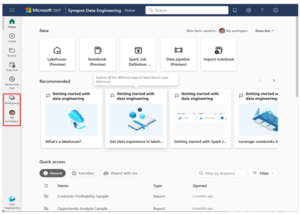
With Microsoft Fabric, you can configure workspaces based on your use cases and processes. You may work together with others to produce reports, notes, lake cottages, and other things in a workspace.This picture depicts what a data engineer's Microsoft Fabric workplace would look like.
Next, let’s look at the various components that make up Microsoft Fabric.
Microsoft Fabric architecture: The core components of the Microsoft Fabric
Seven workloads are part of the Microsoft Fabric architecture, and they operate on top of One Lake, the storage layer that eventually pulls data from Google Cloud Platform as well as Microsoft platforms and Amazon S3.Among these tasks are:
Data Factory: The data integration service
Microsoft Synapse Analytics offerings: Microsoft Synapse Analytics tools have been integrated into Microsoft Fabric. These are:
Synapse Data Warehousing: Lake-centric warehousing that scales compute and storage independently
Synapse Data Engineering: A Spark service for designing, building, and maintaining your data estate to support data analysis
Synapse Data Science: A service to create and deploy end-to-end data science workflows at scale
Synapse Real-Time Analytics: Cloud-based analysis of data from apps, websites, and device
Power BI: Microsoft’s flagship business intelligence service
Data Activator: A no-code experience for data observability and monitoring
One Lake as the Storage Layer
One Lake is a central data repository for Microsoft Fabric, designed using a Lake house architecture. It stores all data in the Delta Lake format, abandoning relational storage. The open-source nature of Delta Lake makes One Lake's architecture also open, allowing integration with any product that can read from a Delta Lake.One Lake's data hub serves as the central unit for finding, exploring, and using various data assets within Fabric.A valuable feature of One Lake is the ability to create shortcuts that point to other data locations, such as ADLS Gen2 or AWS S3. This eliminates the need to make multiple copies of data assets.
Unified data platform: One Lake provides a unified platform for all data types, including structured, semi-structured, and unstructured data.
Data governance and security: One Lake incorporates robust data governance and security features to ensure data quality, compliance, and protection.
Scalability and performance: One Lake is designed to scale to handle large volumes of data and deliver high performance.
Integration with Azure services: One Lake seamlessly integrates with other Azure services, such as Azure Synapse Analytics, Azure Data Factory, and Azure Machine Learning, to enable end-to-end data analytics and AI workflows.
Overall, One Lake offers a powerful and flexible data platform for organizations looking to manage and analyse their data effectively.
What’s new ever since Fabric’s GA announcement in November 2023?
Since the launch during Build 2023, Microsoft has introduced several capabilities, such as:
Shortcuts: Virtualize data in One Lake without moving or duplicating it; Shortcuts are available for One Lake, Azure Data Lake Storage Gen2, Amazon S3, and Microsoft Dataverse.
Mirroring (a data replication capability): Access and manage any database or warehouse from Fabric without switching database clients; Mirroring will be available for Azure Cosmos DB, Azure SQL DB, Snowflake, and Mongo DB.
Integration with Microsoft Purview: Use Purview’s data security and compliance capabilities to manage sensitive data on Fabric; Use the Microsoft Purview Data Catalog to browse and search through your Fabric assets.
Data Activator in public preview: Since October 2023, Data Activator is available to all Fabric users, without having to sign up to be a preview user.
Copilot in Fabric (public preview): Copilot will be available within the Power BI, Data Factory, Data Engineering, and Data Science experiences. You can use Copilot to build reports, summarize insights, build pipelines, and develop ML models. This preview will roll out in stages.
Microsoft Fabric and AI
Microsoft is integrating Azure OpenAI Service into every level of Fabric to enable data professionals to use generative AI to enhance their everyday tasks. According to Microsoft, Copilot can be used in various Fabric experiences as follows:
In Power BI, create reports and summarize your insights into narrative summaries.
In Data Factory, describe your data ingestion and transformation needs using natural language, and Copilot will handle the rest.
When working in a notebook in Data Engineering or Data Science, use Copilot to quickly enrich, model, analyse, and explore your data.
Microsoft Fabric in action: Data science and real-time analytics
Microsoft Fabric is being used to address various data-related needs, including data warehousing, integration, real-time analytics, data science, and machine learning.Microsoft claims that over 25,000 organizations worldwide, including 67% of Fortune 500 companies, are currently using Microsoft Fabric, with 84% of these companies utilizing three or more workloads.To begin using Microsoft Fabric, you can select the relevant experience during the setup process: Power BI, Data Factory, Microsoft Purview, Synapse Data Engineering, Synapse Data Science, Synapse Data Warehouse, or Synapse Real-Time Analytics.The Fabric workspace will be customized based on the persona you choose. For instance, if you select Data Engineering, you'll see options for setting up the Lakehouse, Notebook, or a Spark Job right at the top.