By clicking “Accept All Cookies”, you agree to the storing of cookies on your device to enhance site navigation, analyze site usage and assist in our marketing efforts.
By clicking “Accept All Cookies”, you agree to the storing of cookies on your device to enhance site navigation, analyze site usage and assist in our marketing efforts.
Redefining Data Engineering: GenAI for Data Modernization and Innovation - RandomTrees
Data engineering, the practice of collecting, transforming, and organizing data for analysis, is poised for a significant transformation with the advent of Generative Artificial Intelligence (Gen AI). Over the years, the field of data engineering has seen significant changes and paradigm shifts driven by the phenomenal growth of data and by major technological advances such as cloud computing, data lakes, distributed computing, containerization, serverless computing, machine learning, graph database, etc.
Modernization in Data Engineering with GenAI
Generation: The Art of Data Creation: Generative AI has emerged as a potent tool for creating synthetic datasets. Generative AI corrects data imbalances, ensuring fair sentiment analysis on e-commerce platforms, enriches training data for natural language processing (NLP) tasks.Ingestion: The Art of Data Assimilation: Ensuring the digital document accurately reflects the original handwritten material. This technology also finds use in enriching real estate listings, normalizing health records data for consistency, transcribing spoken customer service interactions for analytical purposes.Storage: The Vault of Digital Assets: Generative AI to shrink video data sizes, revolutionize storage smart deduplication, employ predictive tiering for cost savings, generating synthetic datasets for new businesses, and restoring old documents.Transformation: Shaping Data for the Future: LLMs facilitate standardizing date formats with precision and translation of complex organizational structures into logical database designs, streamline the definition of business rules, automate data cleansing, and propose the inclusion of external data for a more complete analytical view.Serving: Delivering Data with Precision: The seamless process significantly enhances the user experience, allowing for intuitive data exploration and decision-making without requiring technical query language knowledge.
The significance of GenAI
1. Data’s exponential growth: Gen AI holds the potential to address this challenge by automating data processing tasks, extracting valuable insights from the vast amounts of data.2. Challenges with data quality: Leveraging Gen AI techniques, such as machine learning algorithms and automated data cleaning processes, can notably improve data quality and accuracy, thereby minimizing errors and inconsistencies in datasets.
3. Necessity for automation: Gen AI has the capacity to automate multiple data engineering processes, such as data integration, transformation, and pipeline creation, enabling data engineers to allocate their time to more valuable endeavors.4. Increasing complexity of data integration: Gen AI can play a pivotal role in streamlining data integration which can help in reducing the time taken by product engineers in the productization process by utilizing intelligent algorithms to identify data relationships, map schemas, and enable smooth integration across diverse datasets.5. Concerns about data privacy and security: Gen AI brings forth opportunities and challenges in this regard, as it can aid in identifying and mitigating security risks, while also raising concerns about responsible handling of sensitive data and guarding against algorithmic bias.
Gen AI Unleashed - Unveiling the Data Engineering Frontier
Generative AI with Data Lake: When using Generative AI with Data Lake, you no longer need to define the data lake exclusively using a GUI or JSON template.Generative AI with ETL Pipelines: Generative AI can be used to automate the creation of ETL pipelines. This can save time and effort for data engineers, and it can also help to ensure that ETL pipelines are more accurate and reliable.Generative AI with Data Lineage: By automating the process of collecting lineage metadata, generating visualizations of data lineage, and identifying and troubleshooting data lineage problems.Generative AI with Data Warehouse: Generative AI can help organizations to save time and money, and it can also help to improve the quality and accuracy of the data in their data warehousesGenerative AI with Data Visualization: As Generative AI technology continues to develop, we can expect to see even more innovative ways to use Generative AI to create data visualizations that are more interactive, personalized, and aesthetically pleasing.
Investigating the contribution of Gen AI to data integration and management
Smart data integration: It automatically identifies data relationships, maps schemas, and harmonizes data formats, enabling organizations to establish a unified data view.
Efficient data transformation: Gen AI can automate data transformation processes, thereby reducing manual effort and expediting data preparation for analysis.
Improved data accessibility: Gen AI-powered tools enable business users to access and analyze data independently, reducing dependence on data engineers.
Data integration in real-time: Real-time data integration, powered by Gen AI, empowers businesses with timely insights and enables them to respond swiftly to emerging trends and shifting market conditions.
Establishment of data governance and metadata management: Gen AI can automate data governance processes by automatically capturing and documenting metadata, lineage, and data quality metrics.
Generating new insights: Ability to generate new insights from data that would not be possible to find using traditional methods. This will help in making better decisions and improve the performance of their models.
Creating new products and services(Exploring products): Capabilities that are tailored to the needs of individual users.
Data analysis, Visualization and Reporting(Visualization concepts): Automatic analysis of data, identify patterns and trends. These visualizations would be more engaging and informative than traditional visualizations.
Testing and Code Optimization: GenAI can automate testing processes by generating test cases, code, and synthetic data. GenAI helps data engineers write more efficient code, reducing processing times, lowering infrastructure costs, and improving overall pipeline performance.
Pipeline Auto-Assembly and Other Automation: This automation accelerates the development of new pipelines, reducing manual coding efforts, and ensuring adherence to best practices.
Advantages of Gen AI for automating data engineering tasks
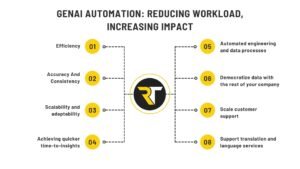
Enhanced efficiency: Gen AI streamlines processes leading to reduced manual effort, faster data processing, and improved overall efficiency in managing extensive data volumes for organizations.
Gen AI brings about heightened accuracy and consistency: Leveraging Gen AI techniques, which possess the capability to process data consistently and precisely, enhances data accuracy, reduces errors, and ensures consistency in data engineering pipelines.
Scalability and adaptability aspects: Gen AI-powered automation offers the much-needed flexibility and scalability to address these challenges effectively.
Achieving quicker time-to-insights: By minimizing manual intervention, organizations can optimize data pipelines, alleviate bottlenecks, and expedite the transformation of raw data into actionable insights.
Automated engineering and data processes: By automating repetitive or mundane aspects of coding and data engineering, generative AI is streamlining workflows and driving productivity for software and data engineers alike.
Democratize data with the rest of your company: LLMs provide a path for team members across the organization to enter natural language prompts that can generate SQL queries to retrieve specific data points or answer complex questions.
Support translation and language services: LLMs like GPT-4 have the potential to help teams provide multilingual customer service interactions, conduct global sentiment analysis, and localize content at scale.
Scale customer support: By incorporating semantic search into basic chatbots and workflows, data teams can enable CS teams to access information, create responses, and resolve requests much more quickly.
ConclusionDriving huge efficiency gains and enhanced model performance, the integration of LLMs and Gen AI with data engineering is set to pave the way for a more agile, innovative and data-driven future. Generative AI, especially through the use of LLMs, is ushering in a renaissance in data engineering. It’s transforming challenges into opportunities, complexities into simplicities, and raw data into insightful narratives. With each phase of the data lifecycle augmented by Generative AI, the potential for innovation is boundless.