The 3:17 a.m. Call That Exposed a Gap in Medical Review
At 3:17 a.m., Dr. Laura Bennett was pulled into a case that looked routine until it did not. A 54-year-old patient named Michael Reynolds had arrived at the emergency department with chest pain. The team was moving quickly. Tests were ordered, vitals were being monitored, and a treatment plan was being considered. On paper, everything looked appropriate.
But Michael’s medical history was not simple. Twelve years of records sat scattered across two hospitals, specialist visits, medication changes, discharge summaries, and scanned reports. Somewhere inside that history was a documented hypersensitivity to a medication being considered in his treatment plan.
Dr. Bennett caught it because she had treated Michael once before. She remembered the detail before the system surfaced it. That moment never appeared in an incident report, but it reveals a dangerous problem. Healthcare professionals are not short on knowledge. They are surrounded by too much information, too many systems, and too little time to connect the dots.
More Data Is Not the Answer. Better Review Is.
The issue is not that information does not exist. In many cases, the right information is already present somewhere inside the record. The problem is whether the right person can find it at the right moment.
Clinical teams spend hours searching, reading, cross checking, and summarizing before they can make or support a decision. That work is necessary, but it is repetitive, time consuming, and difficult to perform consistently at scale. A missed allergy, an overlooked contraindication, an incomplete case summary, or a delayed triage decision can have real consequences.
AI in medical review should not be discussed only as an efficiency tool. It should be discussed to prepare, organize, and surface clinical information before critical decisions are made.
What an AI Medical Review Agent Does in Clinical Case Review
An AI medical review agent should not replace clinical judgment. Doctors, nurses, pharmacists, reviewers, and clinical experts remain responsible for every care decision. AI works earlier in the workflow.
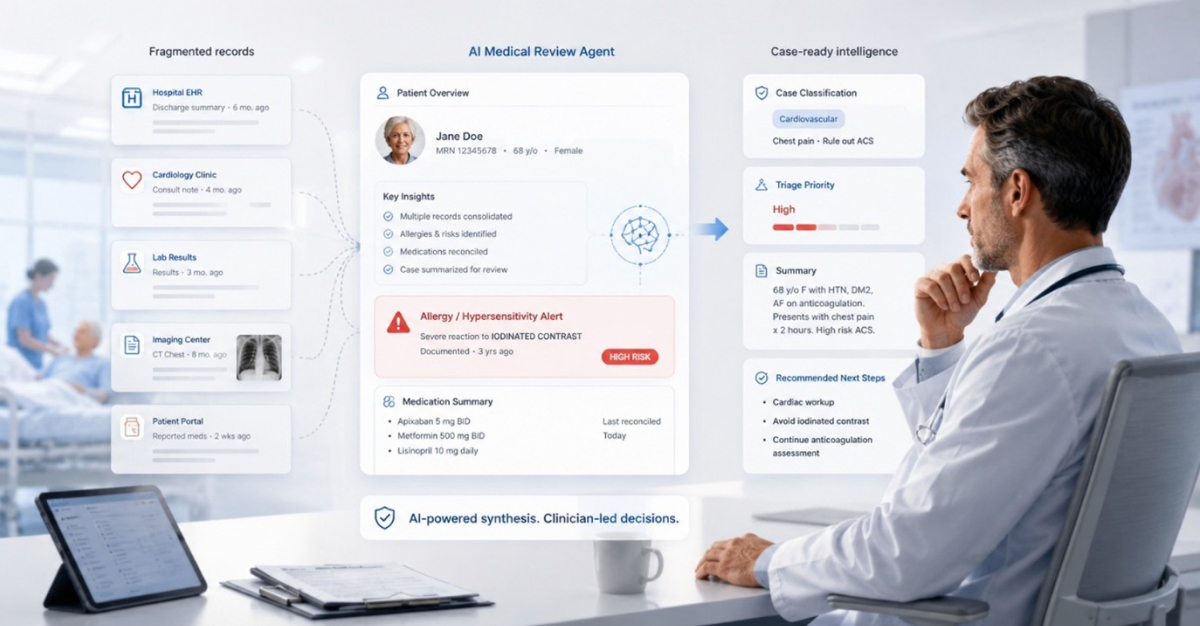
A strong AI medical review agent reads large volumes of medical information, extracts relevant details, identifies risk signals, and prepares a cleaner view of the case. It helps answer the questions that often slow down clinical case review: What is the patient history? What medications are active? Are there allergies or contraindications? Which documents matter most? Is this case urgent? Where should it be routed? What information is missing?
When this work is done manually, review cycles become slower and less consistent. When AI supports it properly, clinicians and reviewers start with a clearer picture. The system helps ensure that the decision begins from better information.
What This Is Not, and Why That Matters
This is not an AI scribe. Scribes listen to a consultation and prepare a visit note. That solves part of the documentation burden, but it does not solve retrospective risk detection. A scribe cannot review years of scattered records to find a buried allergy, an overlooked contraindication, or a missing clinical detail.
This is also not an academic diagnosis benchmark. Research papers often ask whether an LLM can diagnose a condition from a clean case description. Those studies are valuable, but they do not reflect the messy reality of clinical operations. Real medical review involves scanned documents, incomplete records, fragmented histories, missing context, and information spread across multiple systems.
The Med Review Agent is built for the reality most healthcare teams face: fragmented records, incomplete context, scanned files, and decisions that cannot wait. It reads backwards through messy, incomplete records and surfaces what has already been documented but is about to be missed.
How Medical Review Automation Works Across Five AI Agents
In practice, medical review is not one task. It is a chain of smaller decisions. Records need to be collected and read. Relevant data has to be extracted. Files need to be organized. Cases need to be classified. Urgent cases need to be prioritized. The Med Review Agent is structured around that sequence.
1.Medical Review Automation Agent
The Medical Review Automation Agent helps teams process large volumes of medical documents with less manual effort. It scans records, identifies key information, and prepares cases for clinical, operational, or administrative review.
For healthcare providers, this supports faster patient record review. For pharma and life sciences teams, it can help reduce the time required to process case documentation. For insurance and medical review operations, it can improve consistency across high volume workflows. Teams spend less time searching through records and more time acting on what the records reveal.
2.Intelligent Data Extraction Agent
Medical information is rarely clean. Important details are often buried inside unstructured notes, scanned documents, discharge summaries, referral letters, lab reports, and historical records. The Intelligent Data Extraction Agent converts that unstructured content into usable clinical data.
It extracts diagnoses, medication history, allergies, contraindications, lab values, treatment timelines, and relevant clinical observations. This gives experts a cleaner starting point and reduces the inconsistency that often enters manual review.
3.Visual Tagging Agent
Medical records are not limited to text. Healthcare organizations also manage scanned files, diagnostic images, reports, forms, historical archives, and document repositories that are difficult to search and organize. The Visual Tagging Agent helps make these assets easier to retrieve.
It tags, classifies, and organizes files based on visual and document level signals, so teams can find the right information faster. A file you cannot find might as well not exist.
4.Case Classification Agent
Not every case requires the same path. Some cases are routine. Some involve higher risk. Some need specialist review. Some require urgent action. Some can move through a standard queue.
The Case Classification Agent evaluates cases by severity, complexity, urgency, condition type, document completeness, and routing requirements. This helps teams avoid treating every case the same way. Urgent cases should not wait behind routine ones simply because the workflow could not distinguish between them.
5.Triage Agent
Triage is one of the most important points in any clinical workflow. When several cases are waiting, the question is not only what needs review. The question is what needs attention first.
The Triage Agent prioritizes cases based on urgency and risk signals found across available data. It surfaces critical cases earlier, supports queue management, and helps route lower acuity cases into appropriate workflows. A high priority case should not stay hidden inside a crowded queue.
Built for Real Healthcare Systems
Healthcare AI cannot operate as a disconnected layer. It has to meet three realities: interoperability, security, and clinical context.
For interoperability, clinical information sits across systems, formats, and departments. The Med Review Agent supports FHIR for health data exchange and DICOM for medical imaging workflows, helping it aligns with standards already used across healthcare environments.
For security, medical data is sensitive and healthcare workflows are regulated. Any AI system used in medical review must support secure data handling, access control, auditability, and enterprise grade deployment. The Med Review Agent can operate across AWS and Azure, with Snowflake supporting secure and scalable data operations.
For clinical context, healthcare language is nuanced. The difference between a historical note, an active diagnosis, a ruled-out condition, and a current treatment plan matters. The intelligence layer combines advanced language models, clinical NLP, and computer vision capabilities to support medical document review, structured data extraction, visual tagging, case classification, and triage.
A useful AI medical review agent must do more than generate summaries. It must fit into the way healthcare teams actually work.
Why Trust Matters More Than Speed
Speed matters. Faster review, lower cost, higher throughput, and reduced manual effort are real benefits. But speed alone is not enough.
In medical review, the deeper question is whether the system helps teams trust the information in front of them. Can it surface the most relevant details without overwhelming the reviewer? Can it help identify missing information? Can it flag risk signals clearly? Can it support routing without removing human oversight? Can it make review workflows more consistent across teams?
Trust is built when AI improves the preparation of information while keeping clinical judgment in human hands. That is the role of an AI medical review agent. Not to decide for clinicians, but to make sure clinicians, reviewers, and healthcare teams are not forced to make decisions from incomplete or poorly organized information.
The Metric That Really Matters
Healthcare AI will always be measured by operational metrics such as hours saved, cases processed, manual effort reduced, and review cycles shortened. These are important, but they are not the full story.
The more meaningful question is harder to measure: how many critical details did the system help surface before they were missed? The allergy hidden in a long medical history. The contraindication buried in an old discharge note. The urgent case waiting inside a crowded queue. The relevant image or report that would have taken too long to find manually. The missing document that should have been requested before review moved forward.
Dr. Bennett caught Michael’s risk because she remembered. But healthcare systems cannot depend on individual memory alone. They need workflows that help teams remember at scale.
AI Medical Review for Safer Clinical Operations
Manual review alone cannot carry the burden forever. Healthcare, pharma, and life sciences organizations are under growing pressure to process more information, review more cases, and make faster decisions without compromising trust.
The Med Review Agent helps organizations move toward intelligent medical review. Documents are processed faster. Clinical data is extracted consistently. Cases are classified with structure. Triage decisions are supported by better information.
It is built for clinical complexity, designed to support human judgment, and gives healthcare teams a stronger way to see the full picture before important decisions are made.
The Med Review Agent is available on the RandomTrees AI Marketplace, where enterprises can explore ready to deploy AI agents built for real industry workflows. Experience the Med Review Agent live and see how intelligent medical review can support faster case preparation, structured clinical data extraction, case classification, and triage with human oversight at the centre.