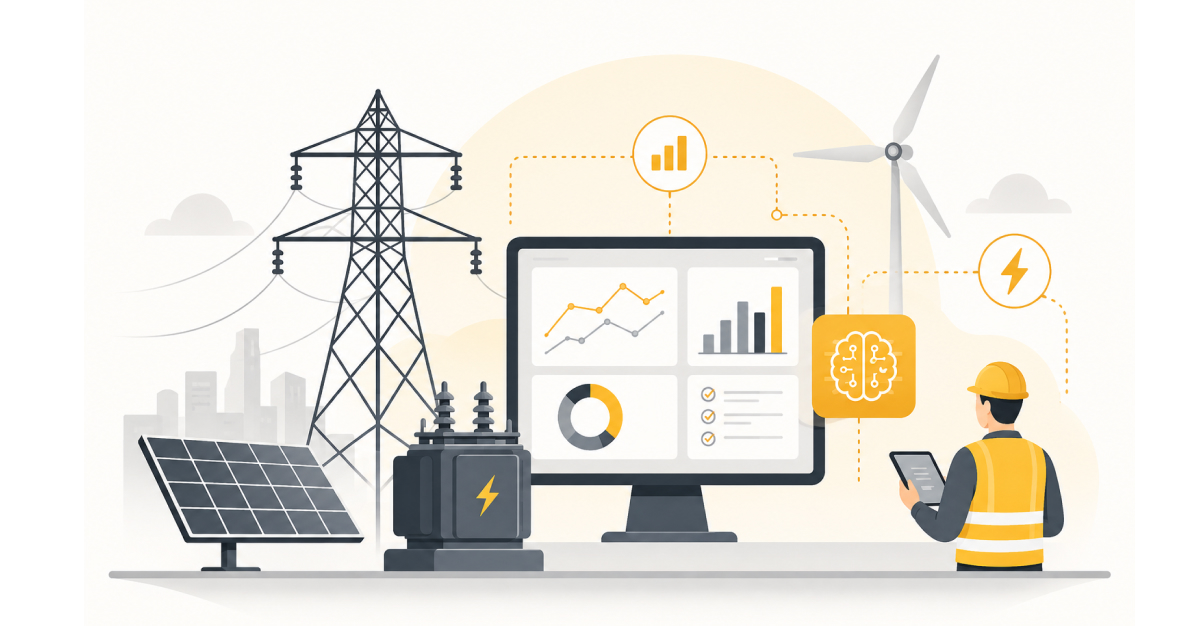
Five grounded ways to connect utility data with operational action
A transformer alarm appears in one system. Smart-meter events arrive in another. Weather data suggests the problem may spread, while customer calls are already reaching the contact center. The data exists, but the operating picture is still incomplete.
The best practical AI use cases for utility operations address this gap. They connect existing signals, identify what deserves attention, and place a recommended action inside the system where operators, engineers, field crews, or service teams already work.
The U.S. Department of Energy (DOE) identifies immediate opportunities for AI across grid planning, operations, reliability, and resilience. These include demand forecasting, predictive maintenance, outage response, and operator decision support (DOE). The opportunity is substantial, but the standard for deployment must remain high: utility AI has to work within strict requirements for safety, reliability, security, and human accountability.
What makes AI practical for a utility?
A useful AI application begins with a defined decision. Which transformer should be inspected first? Has a storm-related fault occurred? Does a revised load forecast require operator attention? Can a customer inquiry be resolved from verified account and outage data?
Four conditions turn a model into an operational capability:
• the input data is available and current;
• the output leads to a specific action;
• the action fits an existing workflow; and
• performance can be measured in operational terms.
An AI agent can coordinate this sequence across approved systems. It may retrieve context, apply business rules, prepare a recommendation, create a work item, and route uncertain cases to a person. The agent still needs boundaries. High-consequence switching, safety, billing, and customer decisions require controls appropriate to their risk.
Five practical AI use cases for utility operations
1. Predictive maintenance and asset prioritization
Maintenance teams often have more potential work than available crews and outage windows. AI can combine sensor readings, asset age, inspection findings, failure history, weather exposure, and maintenance records to identify abnormal behavior and rank assets by risk.
The output should change the maintenance queue. A useful workflow explains why an asset was flagged, retrieves its service history, and prepares an inspection or work-order recommendation. DOE describes predictive and risk-informed maintenance as a way to align service with equipment condition rather than relying only on fixed schedules (DOE AI for Energy report).
Track lead time before failure, false alerts, unplanned failures, asset availability, and engineer acceptance of recommendations.
2. Computer-vision inspection
Drone footage, thermal scans, substation images, and field photographs can exceed the capacity of manual review. Computer vision can flag predefined conditions such as damaged components, corrosion, vegetation encroachment, or missing protective equipment.
Detection alone is insufficient. Each finding must be matched to the correct asset and location, assigned a severity, and sent to a qualified reviewer when confidence is low. Confirmed findings should create or update an inspection record. RandomTrees lists safety and inspection AI among its utility use cases, including the analysis of drone footage for infrastructure damage and site-safety issues (RandomTrees Utilities).
Track inspection coverage, missed-defect rate, false positives, review time, and time from confirmed finding to work order.
3. Demand forecasting and load balancing
Weather, electric vehicles, distributed solar, storage, flexible demand, and large new loads make local demand harder to predict. AI can combine historical consumption with weather forecasts, calendar effects, distributed-energy availability, and network constraints.
The operational workflow should monitor forecast error, update the forecast when conditions change, and show operators the confidence range and main drivers of each revision. RandomTrees describes demand forecasting and load balancing as a utility agent use case based on historical, weather, and consumer data. DOE also identifies renewable-generation forecasting and load-and-supply matching as near-term grid applications (RandomTrees Utilities, DOE).
Track forecast error by time horizon, peak-error rate, operator overrides, and performance during unusual weather or demand events.
4. Outage detection and restoration coordination
An outage may generate SCADA alarms, Outage Management System events, smart-meter messages, weather warnings, customer calls, and field reports. AI can correlate these signals to estimate the fault location, identify affected customers and critical facilities, and prepare a recommended response.
An agent can assemble a crew brief, update the restoration workflow, and trigger approved customer messages when operational status changes. DOE’s resilience use cases include correlating network data with SCADA alarms, outage mapping, crew-dispatch support, and guidance for operators. RandomTrees focuses on connecting SCADA, Advanced Distribution Management System, Outage Management System, and field data to support a consistent operating view (DOE AI for Energy report, RandomTrees Utilities).
Track time to detect, time to localize, dispatch delay, restoration-estimate accuracy, notification latency, and restoration duration.
5. Customer service and billing exceptions
An outage-status question needs live grid information. A high-bill inquiry may require meter reads, tariff rules, weather context, billing history, and open service orders. AI assistants can assemble this evidence, draft an approved response, and transfer ambiguous or regulated cases to a person with the context intact.
The same pattern applies to billing anomalies. AI can compare account, meter, work, and enterprise records; apply defined rules; and route unresolved exceptions to the responsible team. RandomTrees describes utility customer-support agents and identifies billing-anomaly reduction among its enterprise AI examples (RandomTrees Utilities, RandomTrees AI Engineering).
Track first-contact resolution, repeat contacts, transfer rate, response accuracy, exception-handling time, rework, and unsupported-answer rate.
Utility AI depends on operational data readiness
A transformer needs the same identity across the asset registry, SCADA historian, inspection platform, and work-management system. An outage assistant needs a current status, not an old replicated record. A forecasting model must recognize missing meter or weather data.
DOE notes that grid data can be sparse, incomplete, inconsistently formatted, or inaccurate because infrastructure and software have developed across different eras. RandomTrees addresses this issue through pipelines, data harmonization, quality controls, and governance across SCADA, ADMS, OMS, and field systems. Its utilities data-modernization case study describes automated schema, metadata, workflow, and historical-data migration using DFast and DSuite (RandomTrees data-modernization case study).
Before deployment, establish common identifiers, data-freshness checks, lineage, access rules, error ownership, and monitoring for data and model drift.
How to choose the first utility AI workflow
Start where a repeated decision causes visible delay, cost, or risk and where the required data already exists. Define the baseline, the action that will change, and the point at which a person must review or approve the result.
Then test the entire workflow with real data. Model accuracy matters, but so do integration, latency, exception handling, user adoption, auditability, and safe failure. NIST’s AI Risk Management Framework groups lifecycle controls under govern, map, measure, and manage—useful disciplines for utility AI as well as other critical applications (NIST AI RMF).
Put AI inside the utility workflow
Practical utility AI gives people a better basis for the next decision. It can help an engineer prioritize an asset, a reviewer find a defect, an operator respond to a changing forecast, a dispatcher understand an outage, or a service agent resolve a customer issue from verified data.
RandomTrees offers practical, ready-to-deploy, productized AI agents for utility operations through its AI marketplace. The portfolio covers predictive maintenance, safety and inspection, customer support, and demand forecasting and load balancing. Utilities can evaluate agents against their data, systems, policies, and operating measures before expanding into production (RandomTrees Agent Marketplace).
The strongest starting point is one bounded workflow with a clear owner, measurable baseline, defined human controls, and enough operational value to justify the work.