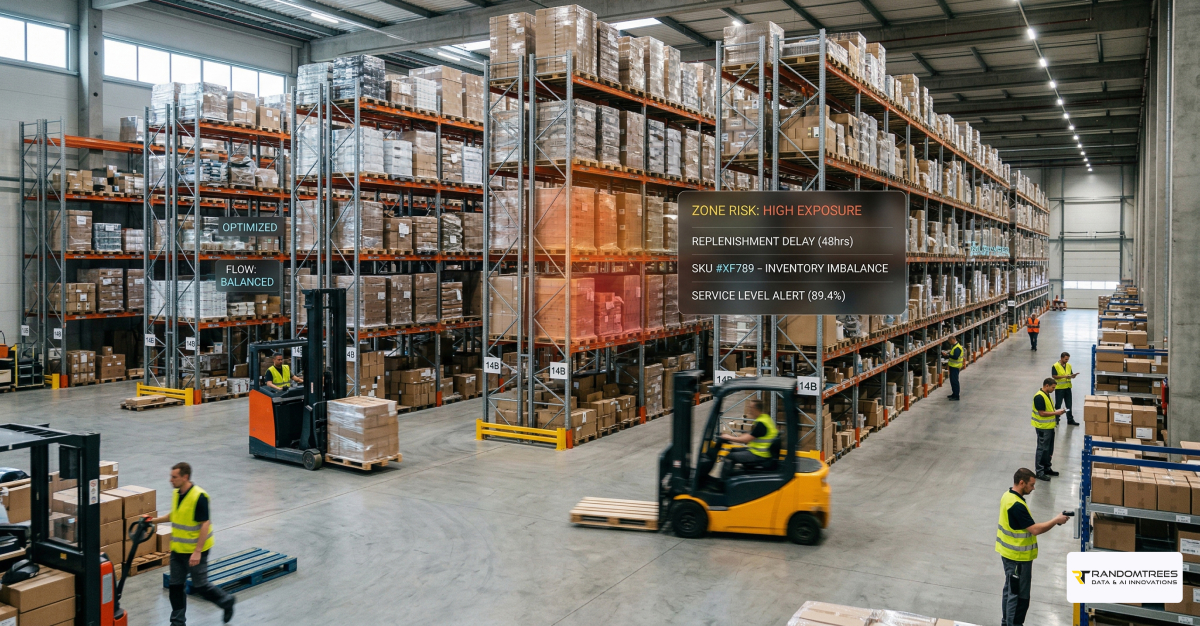
The hidden gap between planning, supply readiness, and fulfilment performance and why enterprises need a live intelligence layer to close it
On paper, nothing was wrong. Inventory coverage looked stable. Forecast numbers were within range. Procurement had followed plan. Yet by midweek, customer teams were already asking where orders were. One region had run short on a fast moving SKU while the same product sat untouched elsewhere. Replenishment was in motion, but too late to matter. By the time the service issue became visible, the business was no longer deciding. It was recovering.
That moment is more common than most planning teams admit. Not because enterprises lack systems, but because the systems they rely on are often designed to confirm control, not expose drift. Demand may have been forecast correctly. Supply may even have been scheduled correctly. But service does not fail only when demand is wrong. It fails when demand, inventory, and replenishment stop staying aligned in time.
Demand planning was never designed to answer the question that matters most
Most planning systems are built to estimate what the business is likely to need. That is useful, but incomplete. A forecast can tell you how much demand is expected. It cannot tell you, on its own, whether the enterprise is actually positioned to serve that demand under real operating conditions. That depends on where stock sits, how quickly supply can respond, how lead times are shifting, and whether the network can absorb volatility without creating exposure somewhere else.
This is where many teams get trapped. They assume planning and readiness are the same thing because they are reviewed in the same meeting. But they are not. One is a prediction. The other is a state of preparedness. The gap between those two is where service risk forms quietly. And most organizations only discover that gap after it has already started affecting customers, channels, or key accounts.
Most systems report failure after it has already become expensive
The enterprise stack is full of useful tools, but most of them are built to observe outcomes, not interpret deterioration. ERP records transactions. Planning platforms generate scenarios. Inventory systems show stock positions. Service metrics tell teams whether fill rate or OTIF held up. Each of these helps explain performance. None of them continuously answers a more urgent operational question: where is the system starting to lose alignment right now?
That is why service protection so often turns into compensation. If planners see uncertainty, they increase buffers. If finance pushes efficiency, safety stock gets trimmed. If supply becomes unreliable, teams start pulling demand signals forward and manually adjusting priorities. These moves may be rational in isolation, but they are still reactions. They do not solve the underlying issue. They simply help the business absorb misalignment after it has already begun spreading through the network.
What breaks is not supply-chain visibility. It is execution confidence
This is why the pain is deeper than stockouts or delayed orders. When service reliability weakens, the business starts losing trust in its own ability to execute. Sales stops trusting inventory. Customer teams stop trusting timelines. Planning stops trusting replenishment assumptions. Leadership sees the numbers, but not the fragility underneath them. And once that happens, every decision starts carrying more urgency, more cost, and less confidence.
This is especially painful in sectors where availability is not just operational but commercially or clinically important. In healthcare and pharma, a missed item can disrupt continuity. In consumer products, availability directly shapes revenue. In industrial supply chains, delays can create downstream disruption far beyond the order itself. In all of these cases, the real cost is not only what was missed. It is the fact that the business saw it too late.
What RandomTrees solves is the timing problem underneath the planning problem
The answer is not another dashboard or a prettier forecast layer. The real need is a system that can continuously detect when service risk is beginning to form before the business feels it in fulfillment. That means connecting demand shifts, inventory position, replenishment readiness, and service exposure in one live decision loop rather than across disconnected reports and teams.
That is where the RandomTrees Demand Planner Agent, Supply Planner Agent, and Service Level Agent come together. The Demand Planner Agent interprets changes in demand behavior and forecast confidence. The Supply Planner Agent evaluates whether the network can realistically support what is coming. The Service Level Agent identifies where that gap is likely to show up first across products, regions, and channels. Instead of waiting for service to fall and then explaining why, the system helps teams see the break forming while there is still time to act.
The shift is not from forecasting to AI. It is from planning to preparedness
This is the more important change. Enterprises do not need more planning theater. They need earlier operational truth. They need to know not only what demand is likely to be, but whether the business is genuinely ready to meet it without over protecting every uncertainty with more stock, more cost, and more manual intervention.
That is what separates a planning function from a resilient operating system. One creates plans. The other protects execution. And in a market where demand moves faster than traditional review cycles and supply conditions rarely stay clean for long, that difference becomes strategic very quickly.
Service failure does not begin at fulfillment
By the time an order is delayed, the problem is already old. The real failure begins earlier, at the moment the enterprise loses live alignment between what the market is asking for and what the network is actually ready to serve. That is the moment most systems still miss. And that is exactly where the next generation of planning intelligence has to operate.
The companies that will outperform are not the ones with the most forecasting dashboards. They are the ones that can detect drift before it becomes loss, intervene before it becomes escalation, and protect service before customers ever see the crack. That is the real planning advantage now. And that is the problem RandomTrees is built to solve.