The delay in commodities isn't in the movement of molecules; it’s in the "Time to Truth."
There is a silent gap in operations that shapes daily risk. A truck has loaded, a railcar is in transit, or a pipeline transfer has finished. In the physical world, custody has shifted and inventory has changed. Yet, inside the ETRM and ERP, nothing has moved. The trade desk is looking at yesterday’s position, and inventory visibility is playing catch-up.
This isn't a document delay. It is a latency of reality. In a business where timing defines value, the system that learns late operates at a structural disadvantage.
The Physical Chain vs. The Digital Shadow
In most environments, the physical execution outpaces the digital chain of control. Because the enterprise hasn't "internalized" the movement in a form the system can trust, traders and schedulers work from an outdated version of reality.
The consequences are immediate and operational:
- Threshold Volatility: Volume movements are invisible when tolerance limits matter most.
- Ghost Inventory: Terminal positions appear stable even as supply has already shifted.
- Reactive Decision-Making: Downstream teams allocate resources based on a system state that is technically correct but temporally wrong.
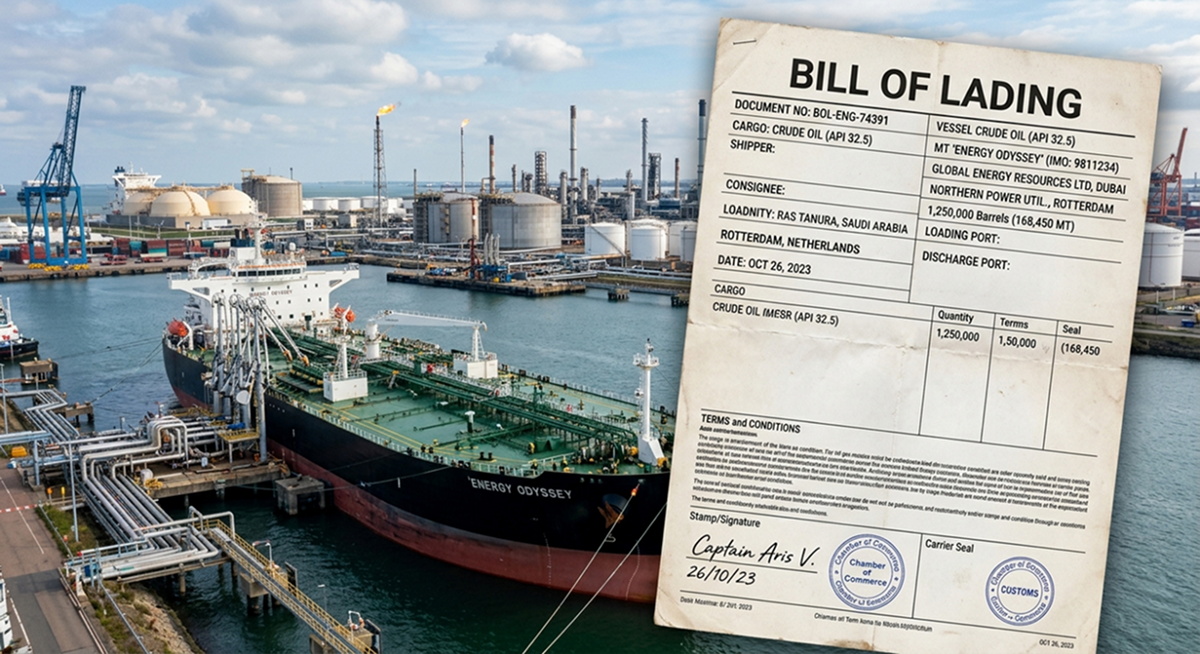
By the time the Bill of Lading (BOL) is finally captured and aligned, the window to influence the outcome has often closed.
Why Automation Has Failed the BOL
Most attempts to fix this focus on document handling—better OCR, faster templates, or automated routing. These tools reduce manual effort, but they fail to solve the core constraint.
The bottleneck is no longer reading the document; it is resolving its meaning.
Workflows fail where extracted data hits the "Internal Logic Wall." Carrier terminology conflicts with enterprise definitions, product names don’t match internal masters, and shipment identifiers remain ambiguous. Standard automation simply delivers these errors to your team faster. Humans are still left reconciling mismatches to make the data "usable," which is where the delay actually lives.
From Static Documents to Execution Intelligence
A Bill of Lading is not a file to be stored; it is a confirmation of execution. It is a signal that ownership has shifted and the system state must evolve.
To close the gap, the industry must shift from document processing to an Execution Intelligence Layer. This means:
- Instant Retrieval: Capturing data across fragmented channels (PDF, portal, scan) the moment it’s generated.
- Semantic Alignment: Automatically resolving product grades, locations, and identifiers against internal business logic before they hit the ETRM.
- Proactive Exception Handling: Surfacing mismatches—like quantity discrepancies—immediately, rather than deferring them to month-end reconciliation.
The Bottom Line: Faster Truth
When BOL data becomes usable the moment a shipment moves, the business regains control. Traders gain visibility while commercial decisions are still in motion, and operators see inventory shifts early enough to respond.
The future of commodities operations isn't a transition from paper to digital. It is a transition from delayed awareness to decision-ready truth. In this market, the system that learns last is the system that loses control first.
How RandomTrees Approaches This
At RandomTrees, BOL workflows are treated as part of a broader execution intelligence layer inside commodities operations with Agentic AI. The focus is not on processing documents faster, but on ensuring that operational signals are captured, aligned, and reflected in enterprise systems in time to influence decisions.
That means continuously retrieving incoming BOL data across fragmented channels, resolving it into business context, and updating ETRM and ERP systems with far less delay and far greater reliability.
Because in this business, better decisions do not come from more data. They come from knowing what already happened, before the moment to act has passed.