By clicking “Accept All Cookies”, you agree to the storing of cookies on your device to enhance site navigation, analyze site usage and assist in our marketing efforts.
By clicking “Accept All Cookies”, you agree to the storing of cookies on your device to enhance site navigation, analyze site usage and assist in our marketing efforts.
Healthcare Intelligence Needs a New Listening Layer
Why public health, pharma, and medical affairs need AI-powered social intelligence to understand real-world healthcare sentiment, expert influence, and emerging health signals.
Healthcare has always depended on evidence. Clinical trials, medical publications, patient surveys, physician feedback, advisory boards, and market research have shaped how organizations understand disease burden, treatment behavior, patient needs, and professional opinion.
These channels still matter. They remain essential to scientific validation, clinical decision-making, and regulatory discipline.
But they no longer capture the full reality of healthcare conversations.
A significant part of healthcare sentiment now exists outside formal research environments. Patients discuss symptoms, side effects, treatment journeys, access issues, and care experiences in digital communities. Healthcare professionals share views through online forums, professional networks, webinars, conferences, publications, and social platforms. Public health narratives evolve rapidly during disease outbreaks, misinformation waves, policy changes, drug launches, and safety concerns.
Healthcare opinion is no longer formed only inside hospitals, journals, surveys, and advisory boards. It is also shaped in real time across fragmented digital ecosystems.
The Intelligence Gap in Healthcare Decision-Making
The problem is not that healthcare organizations lack data. In many cases, they have more data than ever before.
The problem is that much of this data is delayed, scattered, unstructured, and difficult to interpret at scale.
Traditional healthcare intelligence methods often depend on structured research cycles, field reports, periodic surveys, manual monitoring, and retrospective analysis. These approaches provide depth, but they are not always fast enough to capture emerging shifts in public sentiment, professional opinion, or population-level health concerns.
By the time an insight reaches a strategy team, policy function, medical affairs group, or public health body, the conversation may have already moved.
This creates a growing gap between what healthcare organizations formally know and what patients, professionals, and communities are actively expressing.
That gap matters.
It can affect how pharma companies understand treatment perception. It can influence how public health teams respond to misinformation. It can shape how medical affairs teams identify expert voices. It can determine how quickly organizations detect emerging concerns, unmet needs, or trust issues across different population groups.
Social Listening Is Becoming a Serious Healthcare Intelligence Layer
Social listening in healthcare is no longer only a marketing activity. It is becoming a strategic intelligence capability across public health, pharma, and medical affairs.
Global healthcare leaders are already moving in this direction.
WHO frames social listening as an important component of infodemic management, especially during public health emergencies where misinformation, community concerns, and behavioral response can directly influence health outcomes.
McKinsey’s view of future medical affairs points toward broader digital stakeholder engagement. Medical affairs is expected to move beyond traditional key opinion leaders and engage a wider ecosystem of community physicians, payers, experts, and decision-makers.
FDA and pharmacovigilance research highlight the value of digital safety signals, while also reinforcing that these signals must be handled with strict compliance, validation, and regulatory discipline.
Deloitte’s perspective on pharma and patient experience further strengthens the point that trust is shaped not only by what healthcare brands claim, but by what patients experience and what the public perceives.
Together, these perspectives validate a clear shift: healthcare intelligence is expanding from structured institutional channels into real-world digital conversations.
The Challenge: Listening Is Not Enough
Healthcare social intelligence cannot be built by simply collecting mentions, hashtags, keywords, or engagement metrics.
Healthcare conversations are sensitive. Patient experiences can be emotionally complex. Professional opinions can be context specific. Public discussions can be influenced by misinformation, fear, access barriers, cultural differences, and incomplete understanding. Expert influence can also carry bias, conflicts of interest, or uneven representation.
This means healthcare organizations need more than dashboards.
They need systems that can understand context, classify sentiment, identify patterns, detect risks, map expert influence, and apply governance around sensitive insights.
A responsible healthcare intelligence system must answer questions such as:
What are patients and caregivers expressing about a condition, treatment, or care experience?
How are healthcare professionals responding to new therapies, policy changes, or public health developments?
Which demographic groups are showing rising concern, confusion, or trust gaps?
Which expert voices are shaping scientific and professional opinion?
Where are misinformation risks or safety signals beginning to emerge?
Which insights require compliance review, human validation, or escalation?
This is where AI agents can move healthcare social listening from passive monitoring to structured intelligence.
Introducing the Healthcare Professional Social Insights Agent
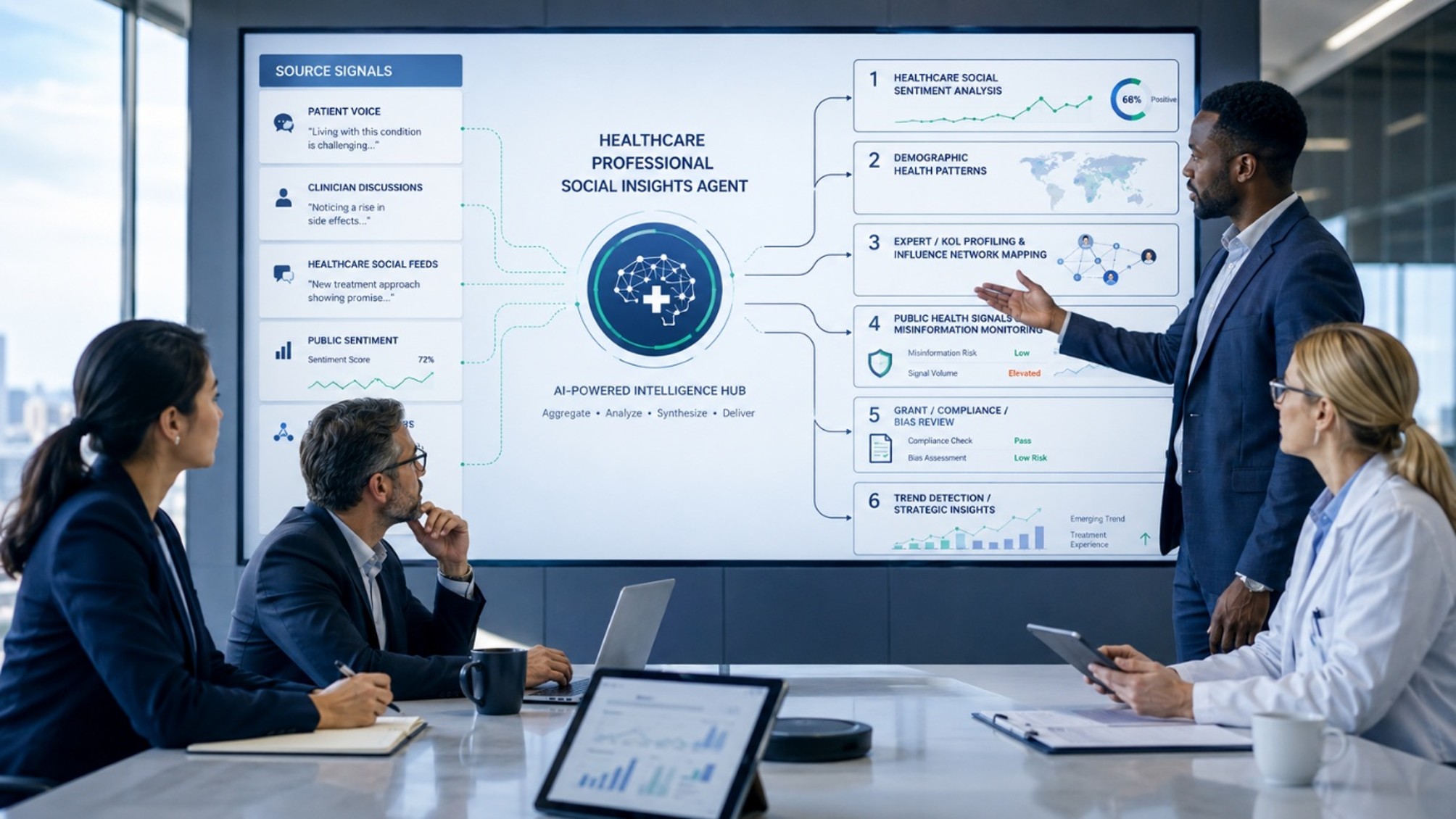
The Healthcare Professional Social Insights Agent is an AI-powered intelligence system designed to analyze healthcare-related social sentiment, professional opinions, expert influence, and demographic health patterns across diverse populations and data sources.
It acts as an orchestration layer for healthcare intelligence.
Instead of relying only on manual monitoring or retrospective reports, the agent coordinates sentiment analysis, demographic intelligence, trend detection, expert profiling, funding review, bias checks, and compliance-aware workflows.
Its role is not to replace healthcare experts, researchers, public health professionals, or medical affairs teams. Its role is to help them see the signals earlier, interpret them with context, and act with greater confidence.
How the Agent Works
The agent brings together multiple specialized capabilities to convert fragmented healthcare conversations into actionable intelligence.
The Sentiment & Demographic Analysis Agent analyzes public opinion, stakeholder sentiment, and population-level patterns. It helps classify healthcare conversations by sentiment, concern level, topic, geography, demographic group, therapy area, or stakeholder type.
The Insights Agent identifies recurring themes, emerging trends, unmet needs, and predictive signals. It turns scattered conversations into structured intelligence that can support strategic planning, public health communication, patient engagement, and medical affairs decision-making.
The Grant Review Agent adds a governance layer by supporting funding analysis, bias detection, document review, and compliance monitoring. This is especially valuable in healthcare research and public health environments where fairness, transparency, and accountability are critical.
The Expert Profiling Agent maps healthcare professionals, researchers, digital opinion leaders, and key influencers based on credibility, engagement, relevance, domain authority, and network position. It helps organizations understand not just who is visible, but who is meaningfully shaping professional opinion.
Together, these agents create a more complete intelligence system for modern healthcare.
Where It Creates Business and Public Health Value
For pharma organizations, the agent can support therapy-area strategy, patient experience, medical affairs engagement, KOL mapping, brand perception, treatment sentiment, and early awareness of safety-related conversations.
For public health institutions, it can support community listening, misinformation monitoring, infodemic management, policy response, risk communication, and population-level concern detection.
For healthcare researchers, it can help identify emerging topics, patient-reported concerns, demographic patterns, unmet needs, and areas where further investigation may be required.
For medical affairs teams, it can improve expert identification, stakeholder engagement, scientific communication, and understanding of how professional opinion evolves across digital and real-world channels.
The strongest value lies in speed, scale, and context.
The agent helps organizations move from delayed interpretation to continuous intelligence. It allows them to listen across wider ecosystems, identify meaningful patterns earlier, and connect social signals with strategic healthcare priorities.
Responsible Intelligence Must Be Built In
In healthcare, intelligence without responsibility can create risk.
Social signals must be interpreted carefully. They should not be treated as clinical proof. They should not bypass regulatory workflows. They should not expose patient privacy or overstate uncertain patterns.
That is why the Healthcare Professional Social Insights Agent must be designed with ethical listening, privacy protection, bias detection, compliance routing, and human review at its core.
The goal is not automated decision-making without oversight.
The goal is responsible decision support.
The agent helps healthcare teams identify what deserves attention, what requires validation, and what should be escalated to the right experts.
The Future of Healthcare Intelligence
Healthcare is already being discussed in real time.
The organizations that can understand those conversations responsibly will be better positioned to build trust, respond to emerging needs, engage professionals, support patients, and strengthen public health outcomes.
The future of healthcare intelligence will not depend only on structured reports, closed-room advisory boards, or periodic surveys. It will also depend on the ability to listen ethically, analyze intelligently, and interpret public and professional signals at scale.
The Healthcare Professional Social Insights Agent brings this capability into one integrated system.
It helps public health, pharma, research, and medical affairs teams convert fragmented healthcare conversations into ethical, compliant, and actionable intelligence.
Experience this agent live on the RandomTrees AIMarketplace and see how healthcare conversations become trusted intelligencefor public health, pharma, and medical affairs.