From Endless Follow-Ups to Intelligent Vendor Onboarding
A procurement associate opens a new vendor file on a Monday morning. The tax identification document came in the wrong format. The voided cheque is missing a signature. The business registration certificate looks fine until finance points out the registration number doesn’t match the company name on the invoice. Two weeks in, compliance flags that this particular vendor, a pharmaceutical supplier, also needed a drug license that nobody asked for at intake because the reviewer who processes forms doesn’t work in compliance and had no way of knowing it applied.
The file gets reopened. The vendor gets another email. The clock resets.
This is the loop AI vendor onboarding is built to break.
None of this happens because anyone is careless. It happens because vendor onboarding usually runs as a relay across three teams, procurement, finance, and compliance, each one waiting on the last, with no single person tracking what is actually missing until someone manually checks.
Manual vendor onboarding commonly runs two to four weeks, and closer to ten to fifteen business days in industries where onboarding involves capability checks, certifications, and multi-level approval routing. Regulated categories take longer, because conditional requirements, a drug license for a pharma supplier, an additional certification for a specific product line, tend to surface only when a reviewer happens to notice the vendor’s category, not automatically when the file is opened.
The slower problem shows up later, in the vendor master itself. Audit teams have traced close to a third of duplicate vendor payments back to duplicate or inconsistent vendor records, the kind that build up when onboarding happens over scattered emails instead of one system of record. A vendor master with unverified entries is also where fraud tends to hide, since an unmonitored record with altered bank details can sit unnoticed for months.
The Constraint Is Repetition, Not Effort
Look at where onboarding actually breaks down and it is rarely a diligence problem. Procurement teams check the same fields on every vendor form, by hand, every time. Finance checks bank details the same way for the hundredth vendor as the first. Compliance checks documentation completeness only once the file reaches their desk, which by then has already passed through two other teams that had no way to flag what compliance would need. Each of these checks is repetitive, rule-based, and disconnected from the others, which is exactly the kind of work where something gets missed, not from carelessness, but from doing the same manual check enough times that one slips through.
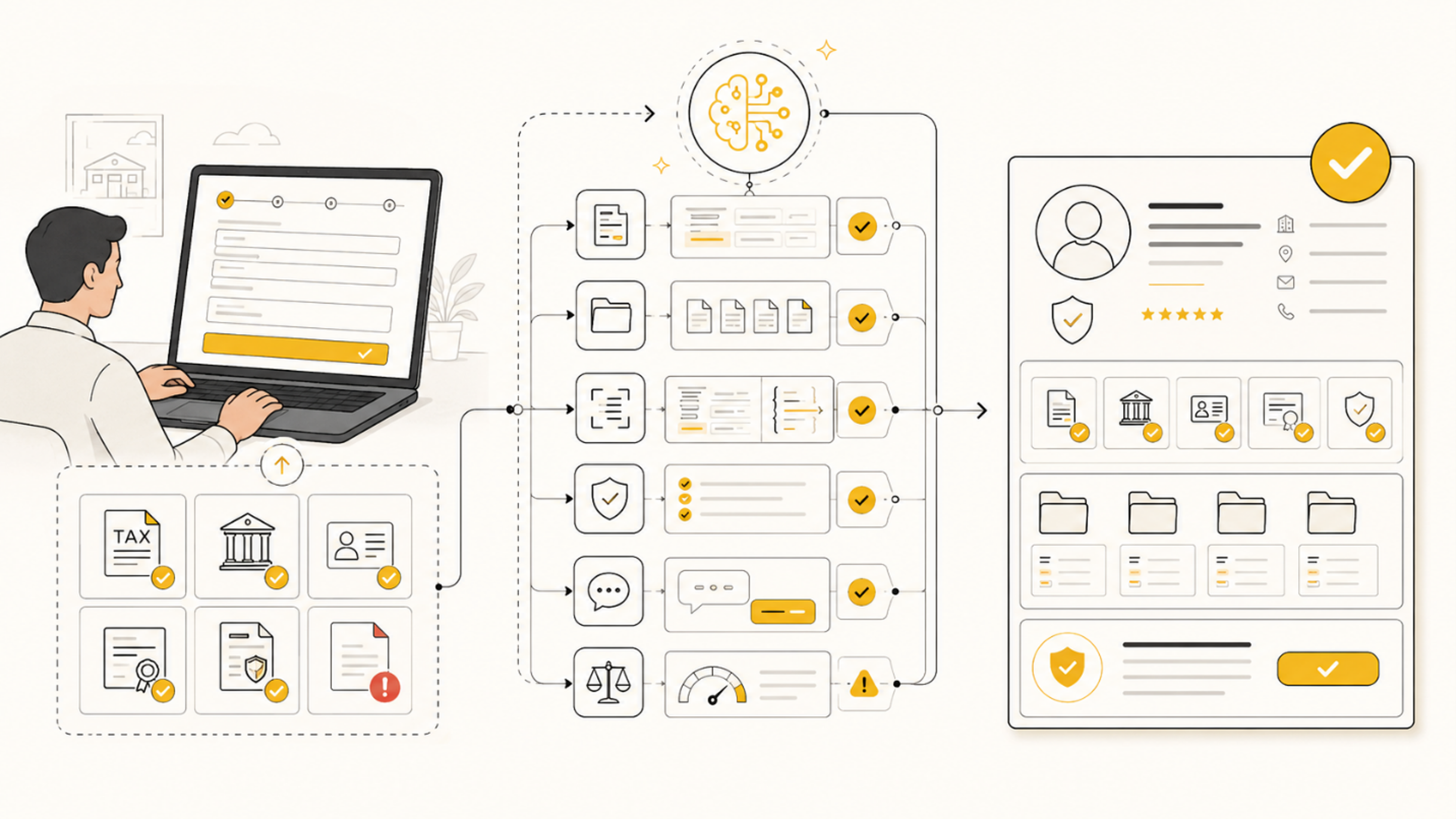
This is where AI vendor onboarding changes the shape of the problem. Instead of a form landing in an inbox and a document folder filling up separately, the vendor’s details, business information, tax details, bank information, are captured through a guided intake process from the start. Documents are organized by vendor automatically as they arrive. Form data and document data are converted into a structured record instead of living as a PDF and a spreadsheet row that someone has to reconcile by hand. Validation runs immediately against that structured record, checking mandatory fields, document completeness, and the formatting of tax identifiers, national ID numbers, and bank account details, whichever format applies for the vendor’s country, a VAT number in the EU, an EIN in the US, a GSTIN in India, or an equivalent elsewhere, along with conditional logic, so a pharma vendor is prompted for a drug license at intake rather than three weeks later.
What AI Vendor Onboarding Looks Like in Practice
RandomTrees built its Vendor Onboarding Agent around this exact sequence rather than around a single generic checklist. A Form Processing Agent handles the guided intake, capturing business details, contact information, tax details, and bank information in one structured pass. A Document Management Agent organizes every upload into vendor-specific folders as it comes in, so nothing sits in a shared inbox waiting to be filed. A Data Extraction Agent converts both the form and the documents into structured data, ready for downstream systems instead of needing manual re-entry. A Validation Agent runs the rule-based and conditional checks: mandatory fields, document completeness, and the correct formatting of tax identifiers, national ID numbers, and bank account or routing details for whichever country the vendor operates in, plus category-specific requirements like a drug license for a pharma vendor. A Chatbot Agent sits alongside this for the onboarding team itself, so a procurement or compliance reviewer can ask, in plain language, what is missing on a given vendor profile and get an answer immediately instead of opening the file to check by hand. A Compliance Agent holds the file until every requirement clears, so what reaches final approval is a complete profile, not a partial one that someone will have to chase later.
It is worth being precise about what the validation actually does. Format and completeness checks, confirming a tax ID or national ID number is structured correctly and that every required field and document is present, catch most of what slows onboarding down today. They are not the same as confirming, in real time, that a tax registration is currently active with the relevant authority or that a license is still valid with the issuing body. Those checks still belong with the compliance team before final sign-off, particularly for higher-risk vendor categories. Automating the repetitive checks is what frees compliance to spend its judgment on the ones that actually need it.
Before and After
Under the old process, onboarding is an email relay. A form arrives, documents arrive separately, someone reconciles the two by hand, and missing items surface one team at a time, often after the file has already moved past the team that could have caught them earliest. Errors get found late, and fixing them means restarting part of the cycle.
Under an agentic onboarding process, the guided form catches missing or malformed fields the moment they are entered. Documents route and validate as they are uploaded, not after a folder review. The onboarding team spots a gap the moment it exists, by asking the chatbot which vendor profiles are incomplete and why, instead of finding out during a manual file review days later. Compliance receives a file that is already complete, or already flagged, rather than one they have to audit from scratch.
That shift shows up in the outcomes procurement, finance, and compliance teams are actually trying to produce: faster onboarding readiness, fewer incomplete or duplicate records reaching the vendor master, less back-and-forth between vendors and internal teams, and a documented trail of what was checked and when, which matters as much during an audit as it does during onboarding itself.
The Vendor Onboarding Agent is RandomTrees’ answer to that problem: an AI vendor onboarding system built and ready to deploy on the RandomTrees AI agent marketplace, designed to sit alongside your existing procurement and finance systems rather than replace them. If vendor onboarding is the process your team dreads every time a new supplier shows up, this is what vendor onboarding automation looks like once it is actually running, worth quietly trying on the next one.