By clicking “Accept All Cookies”, you agree to the storing of cookies on your device to enhance site navigation, analyze site usage and assist in our marketing efforts.
By clicking “Accept All Cookies”, you agree to the storing of cookies on your device to enhance site navigation, analyze site usage and assist in our marketing efforts.
AI Cost Optimization: Why Enterprise Governance Matters
Optimize AI spending while maintaining performance, quality, and accountability.
Your AI bill increased this month. Was it because more people used the system, because tasks became more complex, or because an agent started repeating an expensive step?
Each explanation calls for a different response. Higher spending may reflect valuable adoption. It may also expose a workflow problem that has gone unnoticed.
That is where AI cost optimization becomes an enterprise governance issue. Teams need evidence about consumption and quality, clear responsibility for reviewing that evidence, and a process for deciding what should change.
Why AI cost optimization needs a governance approach
Technical choices determine much of an AI workflow’s cost: which model runs, how much context it receives, how often it retries, and how many steps it takes.
Those choices also affect accuracy, latency, data handling, and reliability.
Replacing a model, for example, requires more than comparing prices. Someone must determine whether the alternative performs adequately, which failures are acceptable, and when a task should escalate to a more capable model or a human reviewer.
Governance establishes how those decisions are made and who is accountable for them.
The FinOps Foundation connects AI cost management with allocation, forecasting, optimization, policy, and governance aligned with business value. That provides a useful foundation for enterprises managing AI spending across engineering, finance, and business teams. FinOps for AI
The practical objective is to connect three things:
Consumption: What did the workflow use, and where did the cost originate?
Results: Did it complete the task to the required standard?
Responsibility: Who decides whether its cost and performance are acceptable?
Without that connection, a lower bill can be mistaken for an improvement even when it comes with more failures or manual rework.
Start by explaining the cost of one workflow
Consider an illustrative procurement assistant that reviews supplier documents and prepares a summary for a buyer.
The workflow retrieves documents, extracts relevant information, generates a summary, and checks whether required details are present. If the check fails, it generates another response.
A rise in spending could have several causes. More buyers may be using the assistant. Supplier documents may have become longer. Retrieval may be returning irrelevant material. The validation step may be triggering repeated generation.
A dashboard showing total model spending would reveal the increase. An execution trace can help explain it.
A useful trace records the sequence of steps alongside the model used, token consumption, cost, latency, inputs, outputs, and failures. Engineers can then investigate which part of the workflow changed.
Suppose the traces show that the assistant repeatedly regenerates an entire summary when only one field is missing. The next step is to test whether a targeted correction can resolve the missing field with less repeated work.
That diagnosis is more useful than applying a broad spending cut across the application. It identifies a specific decision to evaluate.
Trace collection also needs governance. Prompts, retrieved documents, and outputs may contain sensitive information. Access, retention, and redaction requirements should be part of the monitoring design.
Four practical levers for LLM cost optimization
Once teams can explain consumption, they can test changes against the workflow’s requirements.
1. Match model capability to the task
Different steps may require different capabilities. A narrowly defined classification task may perform adequately on a smaller model, while a complex synthesis task may justify a more capable one.
Test the alternative on representative work, including difficult cases. Compare task quality, latency, failure patterns, and any additional escalation or review.
A lower model price is useful only if the resulting workflow remains suitable for its purpose.
2. Improve prompt and context efficiency
Review what the model receives on each call. Long conversation histories, duplicated instructions, irrelevant documents, and oversized retrieval results are candidates for investigation.
For the procurement assistant, the question is whether every step needs every supplier document. An extraction step may need a specific passage, while the final summary may need the extracted facts.
Removing information requires care. Context is unnecessary only when the workflow can still meet its requirements without it. Evaluate completeness and factual consistency after changes.
3. Reduce avoidable retries and repeated work
Retries can help recover from temporary failures. They can also conceal a recurring problem.
Review why a step retries, whether another attempt is likely to help, and when execution should stop or escalate. Where possible, test corrections that address the failed component rather than repeating the entire workflow.
For agentic systems, completion criteria matter. Teams should define what counts as sufficient evidence to finish a task and how an unfinished task is handled.
4. Reuse work where the use case allows it
Some repeated requests may be suitable for caching or reuse of intermediate results. Some non-urgent workloads may be suitable for batch processing.
These options depend on application requirements and provider support. Reused results must remain relevant, current, and appropriate for the requesting user’s access rights. Batch processing must fit the required turnaround time.
Treat each technique as an evaluated design choice, with a clear owner and measurable acceptance criteria.
Make cost controls actionable
AI cost monitoring becomes useful when a signal leads to a defined response.
An alert about rising token consumption does not establish whether the increase is justified. It also does not stop spending. Someone must investigate, make a decision, and verify the effect.
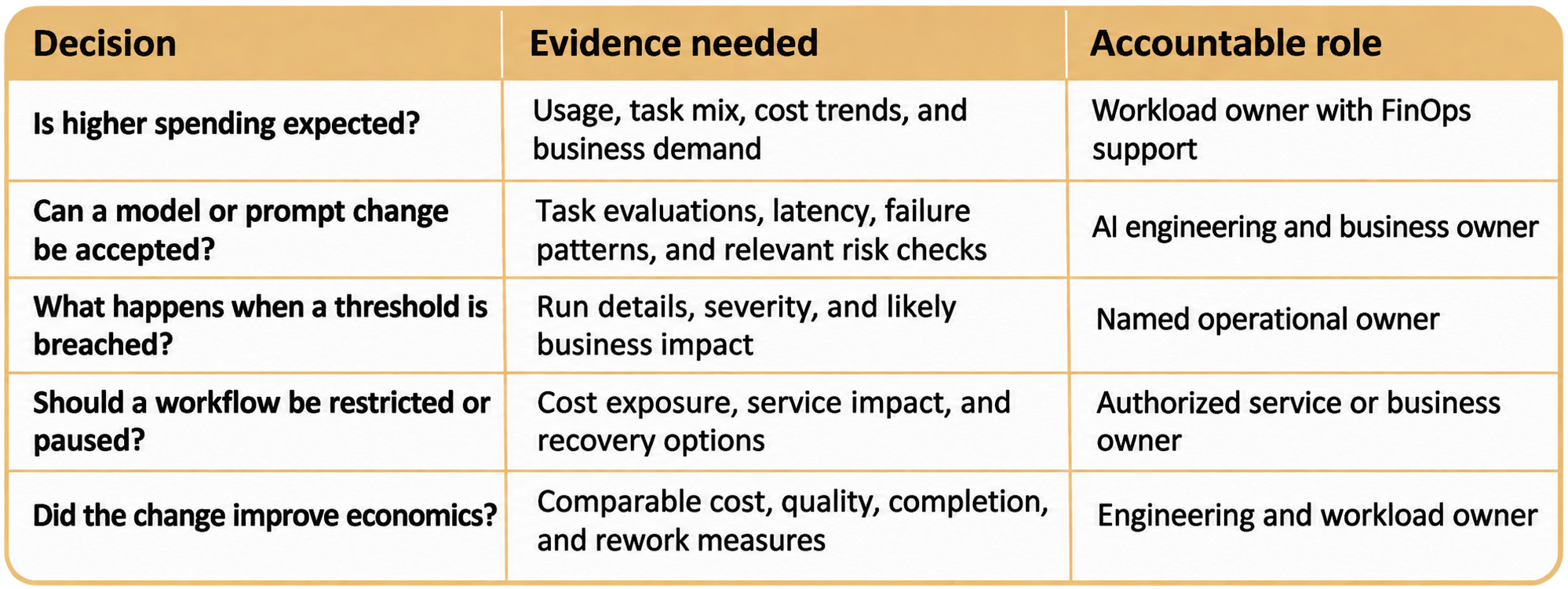
A practical governance model defines the following responsibilities.
Review should be proportionate to the change. A routine prompt adjustment and a model replacement in a sensitive workflow may require different levels of scrutiny.
Distinguish alerts from enforcement. A notification requests attention; an execution limit constrains behavior. If the application needs hard limits on retries, agent steps, or spending, those controls must be implemented and tested in the relevant execution environment.
Measure cost per successful task
Cost per request helps track consumption. Cost per successful task connects that consumption with useful work.
Cost per successful task = total cost within a defined scope ÷ tasks meeting agreed success criteria
The definition of success must come first.
For the procurement assistant, a completed task might require a summary that includes specified fields, accurately reflects the source documents, and passes the buyer’s review. A response that was generated successfully but required substantial correction would not automatically qualify.
Failed attempts belong in the cost calculation. Otherwise, a configuration can appear economical while repeatedly failing to complete the work.
Define the cost scope as well. Model-call spending is one measure. A broader operating assessment may also include retrieval, infrastructure, monitoring, and human review.
Use cost per successful task alongside:
Task success and error rates
Latency
Human review and correction effort
Relevant safety and policy results
Compare similar work. A shift toward more complex requests can raise average costs even when the system’s efficiency is unchanged.
How TrustAI supports the improvement process
The operating process depends on connecting execution evidence with evaluation.
RandomTrees’ TrustAI technical-business white paper describes cost and token visibility across models, steps, and agent runs, alongside execution traces, model and prompt comparison, evaluations, and configurable thresholds.
These capabilities support different parts of the same decision cycle.
Teams can inspect which steps drive consumption, examine the execution behind expensive runs, compare alternative configurations, and assess their effect on task quality. After a change, monitoring provides evidence for reviewing cost, latency, and evaluation results over time.
In the procurement example, this means investigating the repeated generation step, comparing a revised approach against the existing configuration, and checking whether the change preserves summary quality during production use.
RandomTrees also publicly describes TrustAI capabilities for model validation, monitoring, customizable guardrails, and LLM usage observability. Explore TrustAI
The organization remains responsible for setting acceptable performance, assigning owners, and deciding how to respond. TrustAI supports those decisions with a shared operational record.
Begin with one production workflow
Choose a workflow with meaningful spending, a clear owner, and a measurable outcome.
Establish its baseline. Inspect its expensive execution paths. Test one targeted change against agreed quality requirements. Record the decision, then verify the result in production.
Repeating this process makes AI cost optimization part of everyday enterprise governance. Teams can explain where resources went, judge whether the results justified them, and make informed changes as usage evolves.
Explore how TrustAI supports the visibility and evaluation needed to govern enterprise AI operations.
Frequently asked questions
What is AI cost governance?
AI cost governance defines who is responsible for AI spending, how consumption and results are reviewed, and what actions follow when a workload moves outside agreed expectations.
How can enterprises reduce LLM costs while maintaining quality?
Measure a baseline, define task-specific acceptance criteria, and test changes to models, prompts, context, and workflow execution. Evaluate spending alongside task success, latency, and rework before adopting a change.
How does LLM observability help with cost optimization?
LLM observability connects consumption with model calls, execution steps, prompts, latency, and failures. It helps teams identify the cause of higher spending and choose targeted improvements.
How does AI cost governance relate to FinOps for AI?
FinOps for AI connects technology spending with business value through shared financial and operational practices. AI cost governance establishes the responsibilities and decision rules that guide those practices.