By clicking “Accept All Cookies”, you agree to the storing of cookies on your device to enhance site navigation, analyze site usage and assist in our marketing efforts.
By clicking “Accept All Cookies”, you agree to the storing of cookies on your device to enhance site navigation, analyze site usage and assist in our marketing efforts.
LangChain vs LangGraph: Orchestrating the Future of Generative AI Pipelines
The emergence of large language models (LLMs) like OpenAI’s GPT series, Claude, Mistral, and LLAMA has transformed the landscape of natural language processing. While the raw capabilities of these models are staggering, leveraging them effectively in real-world applications requires more than just prompt engineering. That’s where LangChain and LangGraph come in—two powerful open-source tools designed to streamline the orchestration and scalability of LLM-based applications. In this article, we’ll explore the key features, differences, and use cases of LangChain and LangGraph, and how they complement each other in building sophisticated, multi-step AI workflows.
What Is LangChain?
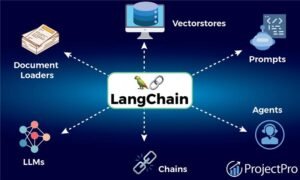
LangChain is an open-source framework designed to help developers build applications that integrate LLMs with external data, memory, tools, and multi-step reasoning. At its core, LangChain enables:
Prompt management for dynamic inputs.
Chains of LLM calls for complex tasks.
Agents that use tools (like web search, Python, SQL, etc.).
Memory to track conversational or task-based context.
Retrieval-Augmented Generation (RAG) for grounding LLMs in external data.
LangChain abstracts the complexities of integrating LLMs with databases, APIs, and user-defined tools. Developers can build agents that not only respond intelligently but can also take actions—such as searching the web, running code, or querying a SQL database.
What Is LangGraph?
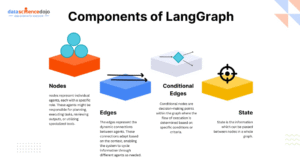
LangGraph builds on LangChain by introducing graph-based orchestration to LLM applications. Inspired by state machines and directed graphs, LangGraph offers more flexible control flows than LangChain’s sequential “Chains.” Key Features of LangGraph:
Stateful workflows: Model how applications progress from one state to another.
Concurrency: Run different nodes in parallel where applicable.
Loops and retries: Ideal for tasks that need verification or iteration.
Event-driven programming: Build agents that wait, respond, or interact based on state changes.
LangGraph is particularly useful when dealing with:
Multi-agent communication.
Human-in-the-loop systems.
Complex decision trees.
Dynamic workflows with conditional logic.
Why Use Both?
LangChain and LangGraph are not competing tools—they’re complementary. Feature LangChain LangGraph Control Flow Linear / limited branching Full graph-based control Best Use Case Simple apps, single-agent tools, RAG Multi-agent systems, async workflows Style Declarative chaining Graph definition with state machines Tooling Many built-in tools (SQL, Web, Python, etc.) Focuses on orchestration over tooling You might start with LangChain to build a proof of concept and then use LangGraph when scaling up to production systems that require complex interactions.
Example Use Case: Multi-Agent Customer Support System
Let’s say you’re building a customer support platform using LLMs. Here’s how LangChain and LangGraph could work together: LangChain:
Each agent (Billing Bot, Tech Bot, Feedback Bot) is created with LangChain using prompt templates, tools, and memory.
You use LangChain’s retrieval capabilities to provide each agent with access to relevant knowledge (FAQs, product docs, past tickets).
LangGraph:
A graph manages the flow between agents.
A user query goes to a router node.
The router decides based on content which agent to activate.
Responses can loop back for clarification or escalate to a human if confidence is low.
This modular design makes it easy to scale, add new bots, or handle special edge cases—all without changing the underlying agent logic.
Real-World Applications
Some practical implementations of LangChain and LangGraph include:
AI Data Analysts: A LangChain agent that interprets user queries, generates SQL, and visualizes data, while LangGraph manages error handling, retries, and summary generation.
Document Q&A Systems: LangChain handles retrieval from a vector database, and LangGraph handles interactions when answers are ambiguous or require follow-up questions.
Chat with Multiple Personas: Each persona is a LangChain agent; LangGraph manages turn-taking and merging outputs.
Observability and Debugging
One of the biggest challenges in production-grade LLM applications is observability. LangSmith (by LangChain team) provides:
Session tracking
Prompt inspection
Token usage analysis
Chain debugging
LangGraph offers verbose logs and state inspection at every node—so developers can troubleshoot errors, model failures, or bad transitions easily.
What's Next?
The evolution from LangChain to LangGraph represents a bigger industry shift:
From prompt-based prototypes → production workflows.
Visual graph editors for non-developers to build LangGraph workflows.
The Future: Interoperability and Standards
Both LangChain and LangGraph are committed to interoperability. With the rise of standards like LangServe and LCEL (LangChain Expression Language), developers can deploy applications via REST APIs or background workers easily. LangGraph also has native support for serverless platforms and distributed compute. As enterprise use of LLMs grows, these tools are poised to become foundational in building robust, maintainable, and scalable AI systems.
Final Thoughts
LangChain brought structure and modularity to LLM app development. LangGraph took it a step further by introducing stateful, event-driven workflows—a game-changer for serious, production-level applications.In a world rapidly moving toward intelligent assistants, autonomous agents, and complex AI workflows, mastering these tools isn’t just a nice-to-have—it’s a strategic advantage.