By clicking “Accept All Cookies”, you agree to the storing of cookies on your device to enhance site navigation, analyze site usage and assist in our marketing efforts.
By clicking “Accept All Cookies”, you agree to the storing of cookies on your device to enhance site navigation, analyze site usage and assist in our marketing efforts.
Enterprise AI in Production: Why Validation, Monitoring, and Control Are Non-Negotiable
Most enterprise AI programs don't stall because the model is wrong. They stall because the business never built the governance architecture to trust it at scale. Here's what actually needs to change.
An AI system recommends that an invoice be approved. The amount looks right, the vendor checks out, and the workflow moves forward. No one notices that the exception logic failed, the supporting context was incomplete, and the approval path should have stopped two steps earlier. Nothing crashes. No alarm fires. The system simply does what it was permitted to do.
That is how enterprise AI risk actually enters a business - not through a spectacular hallucination or a high-profile model failure, but through a plausible output that slips into a live workflow and begins carrying operational weight before the organization has built the controls to contain it.
For CTOs leading AI programs in 2026, this is the defining challenge. Not whether your model can perform. Whether your organization can govern what it performs.
Why Enterprise AI Confidence Breaks in Production - Not in the Demo
There is a persistent and costly assumption in the market: enterprise AI fails because the model produces wrong answers. That diagnosis is technically comfortable and organizationally convenient. It is also, in most cases, wrong.
Enterprise AI prototypes tend to work. The assistant responds, the agent completes the task, the output is convincing enough that stakeholders move the project forward. The problem begins one step later - when the system is granted access to live business workflows, real data, and real consequences.
At that point, the evaluation standard changes. The question is no longer whether the system is useful. It is whether the system is operable - whether it can be constrained, routed, escalated, audited, and explained within the actual logic of your business. A model can be accurate and still be unsafe in execution. An agent can be impressive in a pilot and still be entirely unfit for production.
This is not a prompt engineering problem. It is a runtime governance problem. And as Deloitte's 2026 research confirms, it is a problem that is getting larger - with more enterprise AI systems moving into production and more organizations trying to operationalize AI across critical business workflows before they have the infrastructure to govern it responsibly.
AI Observability Is Necessary - But It Is Not Sufficient
Enterprise AI programs rarely lose stakeholder trust in a single dramatic failure. Trust erodes through smaller, cumulative breakdowns: a workflow produces an output no one can explain; an agent takes an action no one anticipated; a human override point was never defined; model behavior drifts after deployment but the shift goes unnoticed until confidence is already compromised.
In response, many organizations have invested heavily in observability - logs, traces, dashboards, behavioral visibility tools. That investment is well placed. But visibility alone does not create trust, and it does not constitute governance.
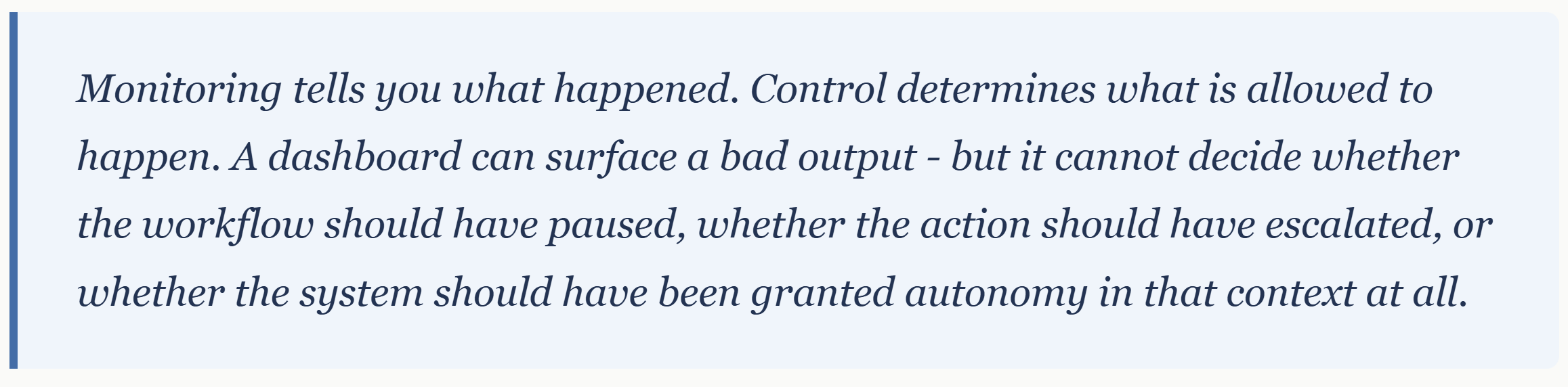
There is a critical distinction that many technology leaders are only beginning to make clearly:
This gap becomes more consequential as organizations move from isolated use cases toward multi-step, tool-connected, and agent-driven systems. Governance is no longer a question of isolated output quality. It is a question of system behavior in motion - across workflow states, decision boundaries, policy contexts, and accountability structures that were never designed with AI participants in mind.
Building only observability infrastructure means building a better view of your own exposure. That is not governance. That is surveillance. And surveillance, without the capacity to intervene, does not make AI deployable.
The Three Capabilities Every Enterprise Needs Before AI Can Be Trusted in Production
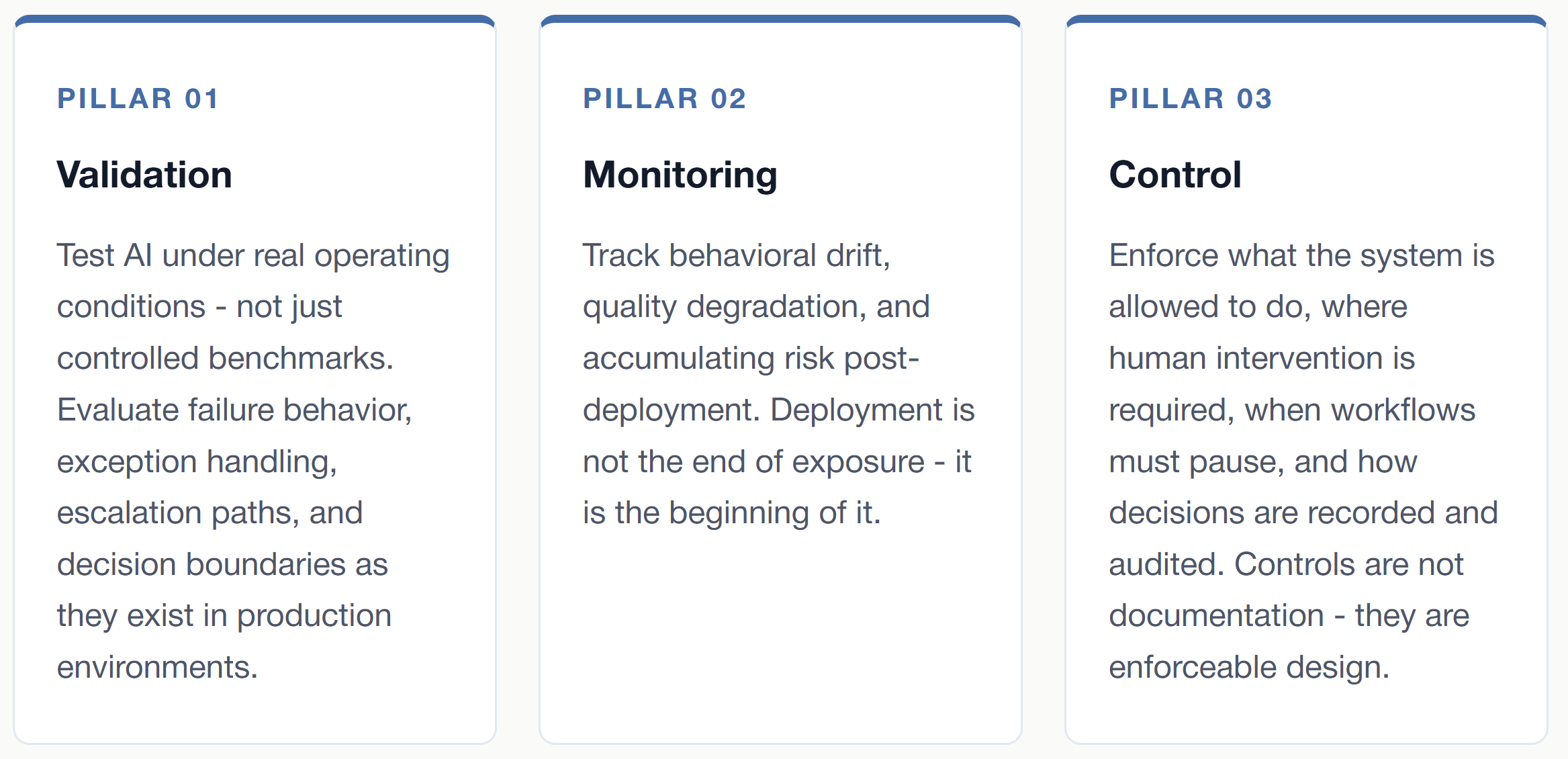
Responsible AI deployment does not require another principles document, another ethics page, or another slide deck reassuring leadership that humans are in the loop. It requires systems that can withstand real operating conditions. That means three foundational capabilities - and these are not adjacent ideas or optional layers. They are the minimum architecture for deploying AI into a business without turning every workflow into an unmanaged risk surface.
Validation: Where Trust Actually Begins
Conventional validation asks whether a model performs well on a clean dataset. That is fine for a benchmark. It is insufficient for a business. The more operationally relevant question is: under real conditions, where can this system fail - and what happens when it does?
That means expanding validation beyond output accuracy to include failure modes, edge cases, exception handling, workflow impact, and acceptable levels of autonomy. Most enterprise AI systems are not under-tested - they are under-contextualized. They are evaluated in environments that are cleaner, calmer, and less consequential than the environments in which they will actually operate.
When those systems are deployed into real business conditions, the resulting trust collapse is treated as a technical surprise. It is not. It is a validation failure. Until enterprises validate AI under the same conditions in which it will be used, they are not testing readiness - they are testing optimism.
Monitoring: Understanding Behavior in Motion
Once deployed, AI systems do not stay static. Usage patterns shift, prompts evolve, underlying data changes, and the assumptions embedded in original workflow designs begin to decay. Post-deployment monitoring must go beyond error detection to track where quality drifts, where behavior changes, where risk accumulates, and where user trust starts to thin.
The key for CTOs is to define what "normal" looks like at deployment and build the instrumentation to detect deviation continuously - not just after an incident has already surfaced in a business process.
Control: The Least Developed and Most Critical Layer
Control is where the majority of enterprise AI infrastructure remains dangerously immature. Once a system becomes operational, governance cannot remain a document, a committee, or a one-time approval ritual invoked for leadership reassurance. Production systems do not respond to principles. They respond to controls.
Effective control defines what the system is permitted to do, what it is explicitly prohibited from doing, where human override is required, when workflows must pause for review, what triggers escalation, and how decisions are preserved for audit. This is precisely what frameworks like NIST's AI Risk Management Framework are designed to formalize - risk management embedded across design, development, deployment, and ongoing operation, not treated as a late-stage compliance checkbox.
Trust in enterprise systems is not created by intent. It is created by enforceable design.
Why AI Pilots Stall - And What the Real Fix Is
This architecture gap is the primary reason so many high-potential AI programs lose momentum after the proof of concept. Not because use cases are weak, models are inadequate, or organizational ambition is lacking. They stall because the system becomes more consequential than the control architecture surrounding it.
That is when the friction begins. Security teams start asking harder questions. Compliance stops offering polite support. Business owners hesitate. Teams lose conviction. Pilots remain trapped in the category of "promising" - which is often corporate language for not safe enough to deploy at scale.
The common misdiagnosis at this stage is that governance is slowing AI adoption down. The evidence consistently points in the opposite direction. The absence of governance is what slows enterprise AI down - because without it, every deployment becomes a negotiation with uncertainty. And uncertainty does not scale inside a business. It spreads, compounds, and eventually kills momentum.
The organizations accelerating through this stage are not doing so by loosening oversight. They are doing so by replacing vague oversight with specific, enforceable controls - making AI risk visible, bounded, and auditable enough that stakeholders at every level can extend trust with confidence.