By clicking “Accept All Cookies”, you agree to the storing of cookies on your device to enhance site navigation, analyze site usage and assist in our marketing efforts.
By clicking “Accept All Cookies”, you agree to the storing of cookies on your device to enhance site navigation, analyze site usage and assist in our marketing efforts.
Accounts Payable Automation and Invoice Intelligence
A Practical Guide for Enterprise Finance
Accounts payable automation has become a strategic priority as finance organizations face rising invoice volumes, increasing regulatory scrutiny, and persistent operational risk. Despite sustained investment in automation platforms and shared service models, accounts payable remains one of the most fragile and error prone functions in enterprise finance.
The root cause is not a lack of effort, and it is not a lack of tools. The deeper issue is fragmented intelligence across the invoice lifecycle.
Invoices enter organizations as unstructured documents through email, supplier portals, and shared systems. Validation rules are applied separately across different tools. Posting decisions occur inside ERP systems, while exceptions circulate through email threads and informal workflows. Each step may operate efficiently on its own, but financial understanding rarely persists across the entire accounts’ payable workflow.
This fragmentation creates invisible finance debt. Delays, disputes, reconciliation effort, and financial leakage accumulate gradually across the process. The impact often becomes visible only after operational trust has already begun to decline.
Why Traditional Accounts Payable Automation Falls Short
Most accounts payable automation initiatives define success through operational efficiency metrics. Invoice processing time decreases, cost per invoice declines, and teams become more productive.
These improvements matter, but they do not solve the deeper structural issue.
Invoices are not simply documents that need to be processed quickly. They represent financial events that influence cash flow accuracy, tax compliance, vendor relationships, and financial reporting.
When invoice processing occurs in fragmented steps, automation increases speed but does not proportionally reduce risk. Optical character recognition systems extract data from invoices. Workflow systems move tasks forward. Human teams reconcile meaning and resolve inconsistencies before posting.
Throughput increases, but financial control remains structurally weak because decision making remains distributed across disconnected systems.
What Is Invoice Intelligence in Accounts Payable
Invoice intelligence in accounts payable refers to systems that interpret invoice data in context, validate it against financial policies, and execute posting decisions with clear confidence levels and governed human oversight.
Instead of focusing only on task automation, invoice intelligence treats invoice processing as a connected reasoning process that moves from interpretation to verification and ultimately to execution inside enterprise finance systems.
The goal is not maximum automation. The goal is reliable financial execution at scale.
Introducing Invoice Automation Agent
Invoice intelligence becomes meaningful only when it operates within real finance workflows. Invoice Automation Agent was designed with this requirement in mind.
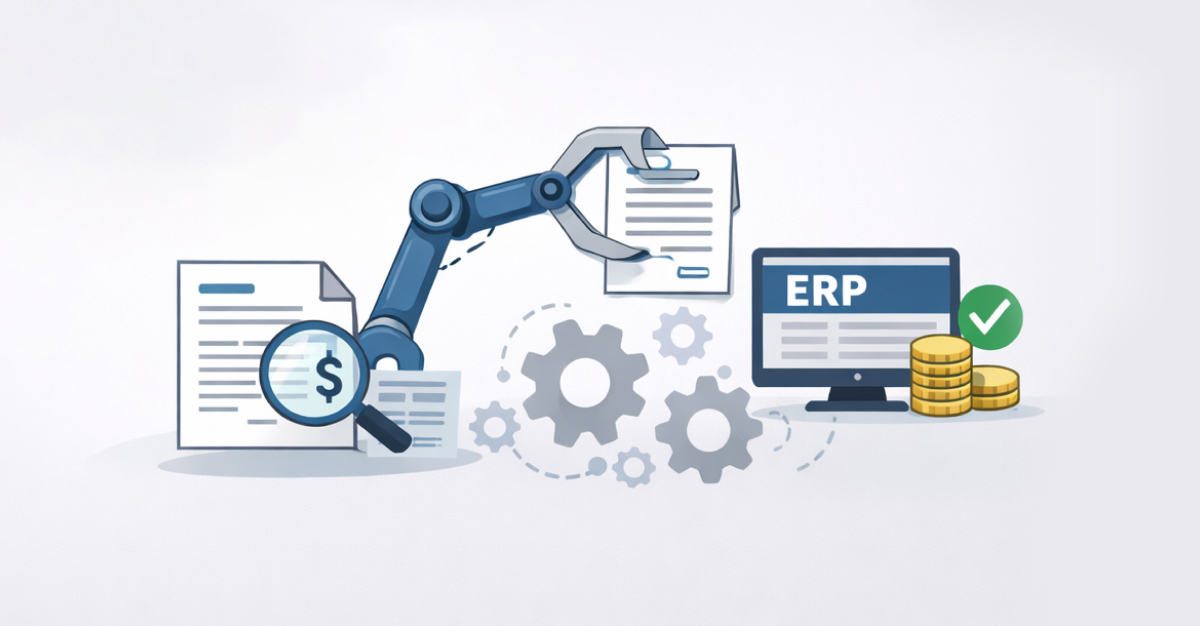
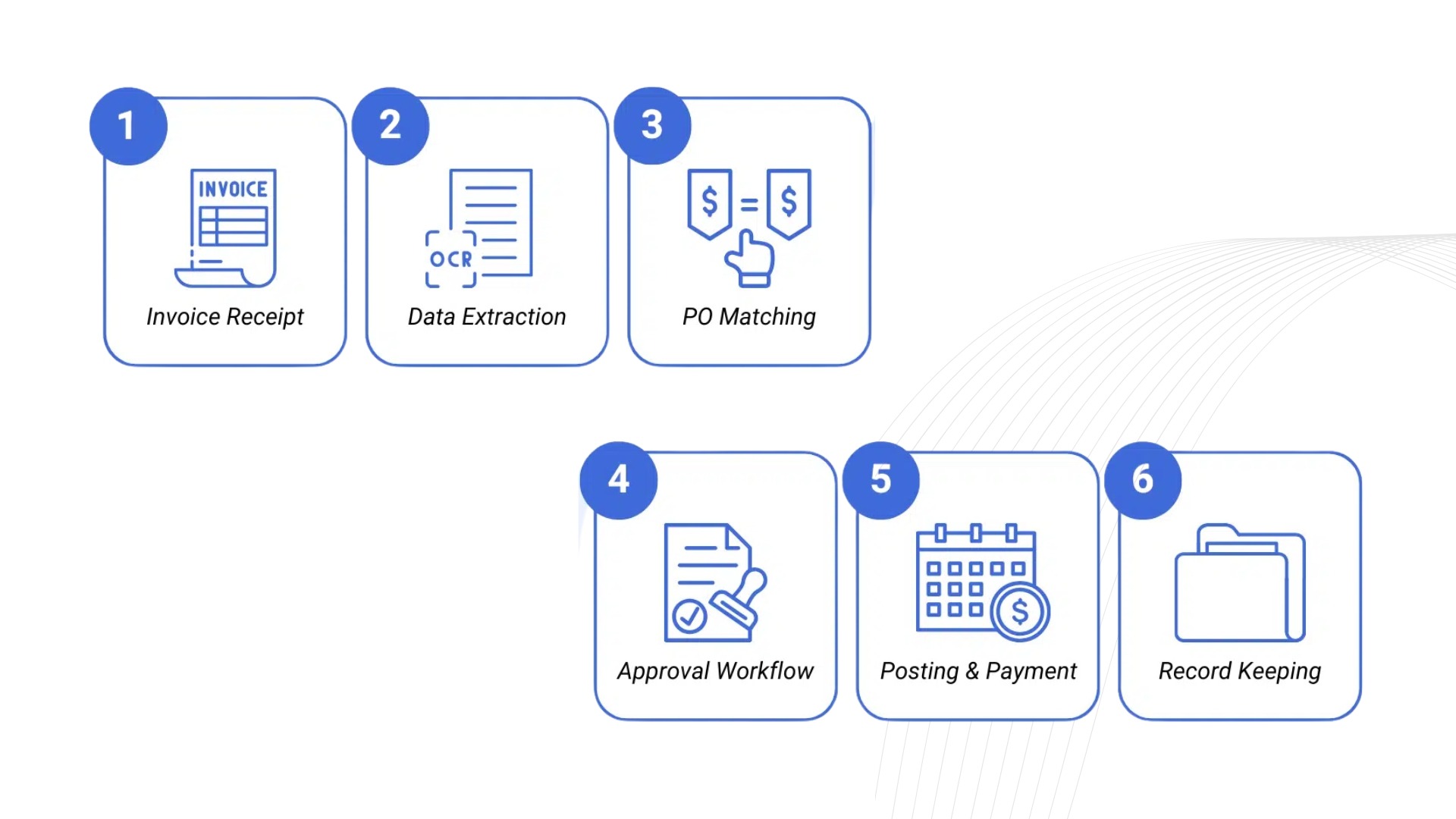
Invoice Automation Agent is a ready to deploy agentic system for accounts payable automation that manages the complete invoice lifecycle from document intake to ERP execution. The system functions as a virtual finance analyst that coordinates interpretation, validation, reconciliation, and audit checks as one connected reasoning process.
Traditional automation tools improve individual steps in invoice processing. Invoice Automation Agent maintains financial understanding across the entire accounts’ payable workflow. Every decision remains contextual, traceable, and governed from the moment an invoice is received to the moment it is posted into the ERP system.
Finance teams can observe Invoice Automation Agent operating within real workflows through the Weave AI Marketplace, allowing organizations to evaluate invoice intelligence in practice rather than relying on conceptual demonstrations.
From Automation to Financial Reasoning
Traditional invoice processing automation focuses on moving data between systems. Invoice intelligence focuses on determining whether that data should move at all.
Financial systems rarely fail because tasks are slow. They fail when decisions are executed without sufficient understanding.
Invoice intelligence systems evaluate whether extracted invoice data is coherent, whether it aligns with financial policies and tax rules, and whether it is safe to execute within ERP environments.
When confidence is high, the system proceeds with execution. When uncertainty remains, the system escalates the issue with a clear explanation for human review. This approach preserves financial control while significantly reducing manual effort across accounts payable teams.
How Invoice Intelligence Works Across Accounts Payable Workflows
Invoice intelligence operates through three connected capabilities that support financial decision making throughout the accounts payable process.
Interpretation involves extracting invoice data and structuring it with context, so the system understands what the invoice represents rather than simply identifying isolated fields.
Verification evaluates extracted information against business rules, tax policies, and consistency checks. Anomalies are detected early and explained clearly, reducing downstream disruption.
Execution ensures that only verified invoices are posted into ERP systems such as Microsoft Business Central. All actions are logged with full traceability and audit visibility.
Each stage supports a financial decision rather than a purely technical task.
The Technology Foundation Supporting Invoice Intelligence
Invoice intelligence systems integrate with existing enterprise infrastructure including secure document storage platforms, workflow orchestration services, communication channels, metadata management systems, and artificial intelligence models for interpretation and reasoning.
This architecture enables invoice processing automation to scale while avoiding fragile integrations or rigid automation pipelines. Intelligence remains adaptive to operational variation rather than dependent on static rules.
What Changes for Finance Teams
When invoices are treated as structured financial events rather than static documents, operational outcomes change significantly.
Accounts payable workflows accelerate without sacrificing financial control. Manual effort declines while accountability remains intact. Exceptions become visible and explainable rather than chaotic. Compliance improves through clearer reasoning rather than additional oversight.
Finance teams move from reactive error correction to proactive financial control.
Why Invoice Intelligence Matters for Enterprise Finance
Automation reaches its limits when systems move faster than organizational understanding. Invoice intelligence closes this gap by embedding financial reasoning directly into execution.
It aligns operational speed with confidence and connects execution with trust.
The future of accounts payable will not be defined by how quickly invoices move through a workflow. It will be defined by how confidently organizations can execute financial obligations at enterprise scale.