As invoice volumes increased, accounts payable automation became a strategic priority for the organization. The enterprise was processing invoices from a global vendor network, with documents arriving in multiple formats and languages across regions.
Despite prior investments in automation, invoice processing remained slow, exception-heavy, and operationally expensive. Finance leadership identified the accounts payable function as a critical bottleneck affecting efficiency, compliance, and vendor experience.
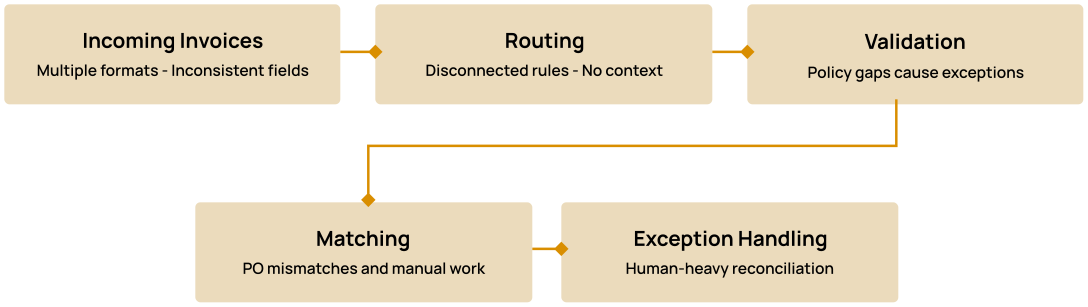
The challenge was not simply scale. It was that invoice execution still depended heavily on human reconciliation across fragmented steps in the workflow.
Traditional accounts payable automation improved isolated tasks such as extraction or routing, but it did not solve the deeper problem of financial interpretation.
Invoices were still treated as documents to process rather than financial events to validate and execute with confidence. As a result, exception handling, policy interpretation, and invoice-to-purchase-order resolution remained fragmented across the workflow.
This created a structural gap between automation and control.
To modernize accounts payable and reduce operational risk, the organization deployed Invoice 360, an intelligent invoice agent designed to bring interpretation, validation, matching, and execution into one governed workflow.
The biggest shift was not just in processing speed. It was in how finance teams operated.
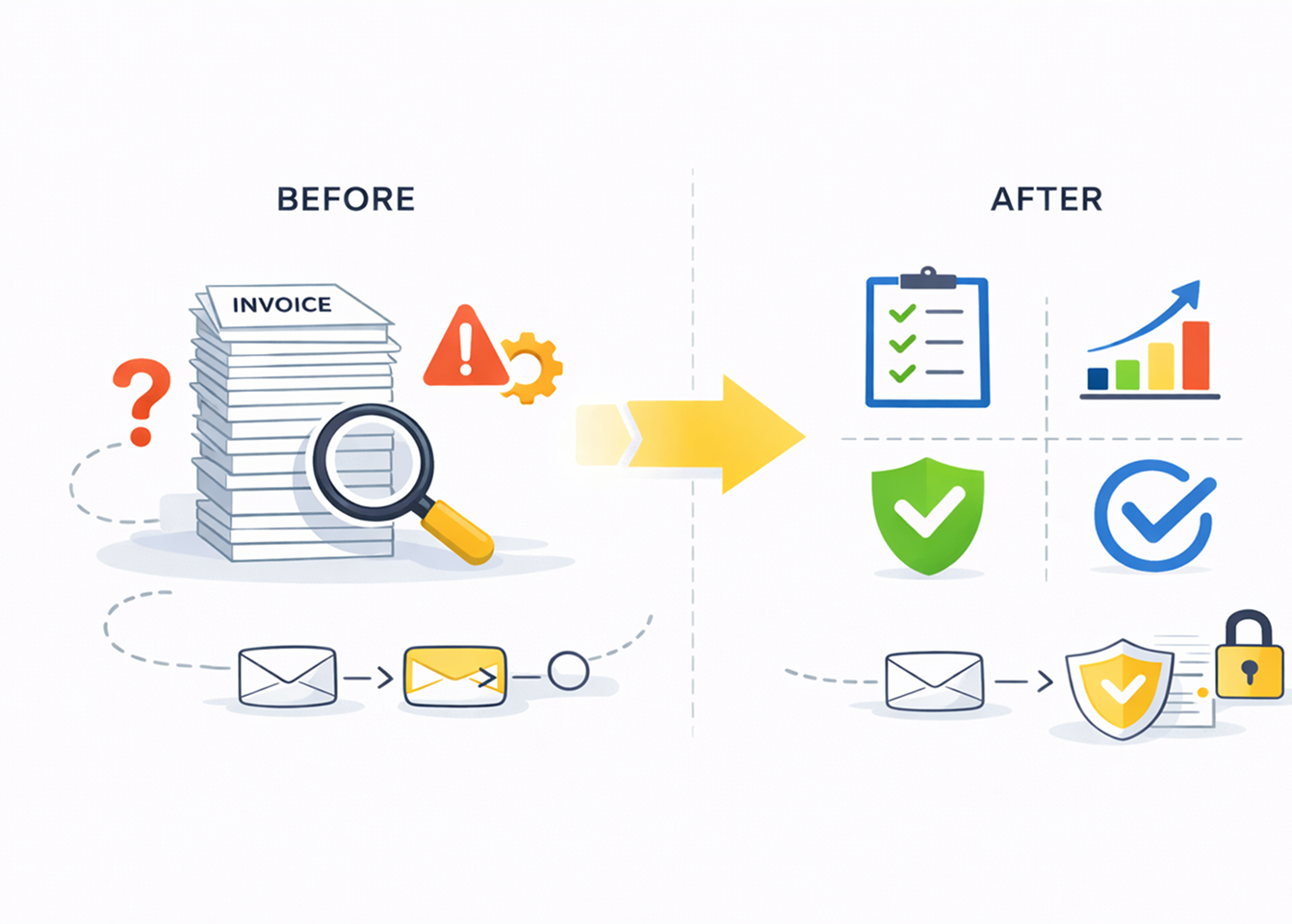
Before deployment, teams were spending time on repetitive handling, reconciliation, and exception chasing. After deployment, that work moved into a more governed workflow where invoice decisions were visible, traceable, and easier to control.
Finance teams were no longer buried inside the mechanics of invoice movement. They were positioned closer to where real value lives:

The biggest shift was not just in processing speed. It was in how finance teams operated.
Before deployment, teams were spending time on repetitive handling, reconciliation, and exception chasing. After deployment, that work moved into a more governed workflow where invoice decisions were visible, traceable, and easier to control.
Finance teams were no longer buried inside the mechanics of invoice movement. They were positioned closer to where real value lives:
As invoice volumes rise and enterprise finance operations become more distributed, traditional automation reaches its limit.
Organizations do not just need invoices to move faster. They need systems that can align speed with accuracy, execution with oversight, and automation with trust. Invoice intelligence makes that possible by embedding reasoning directly into the workflow rather than leaving judgment scattered across manual interventions.
The future of accounts payable will be defined not by how quickly invoices move through a system, but by how confidently organizations can execute financial obligations at scale.